Understanding Risk vs Reward in Investing
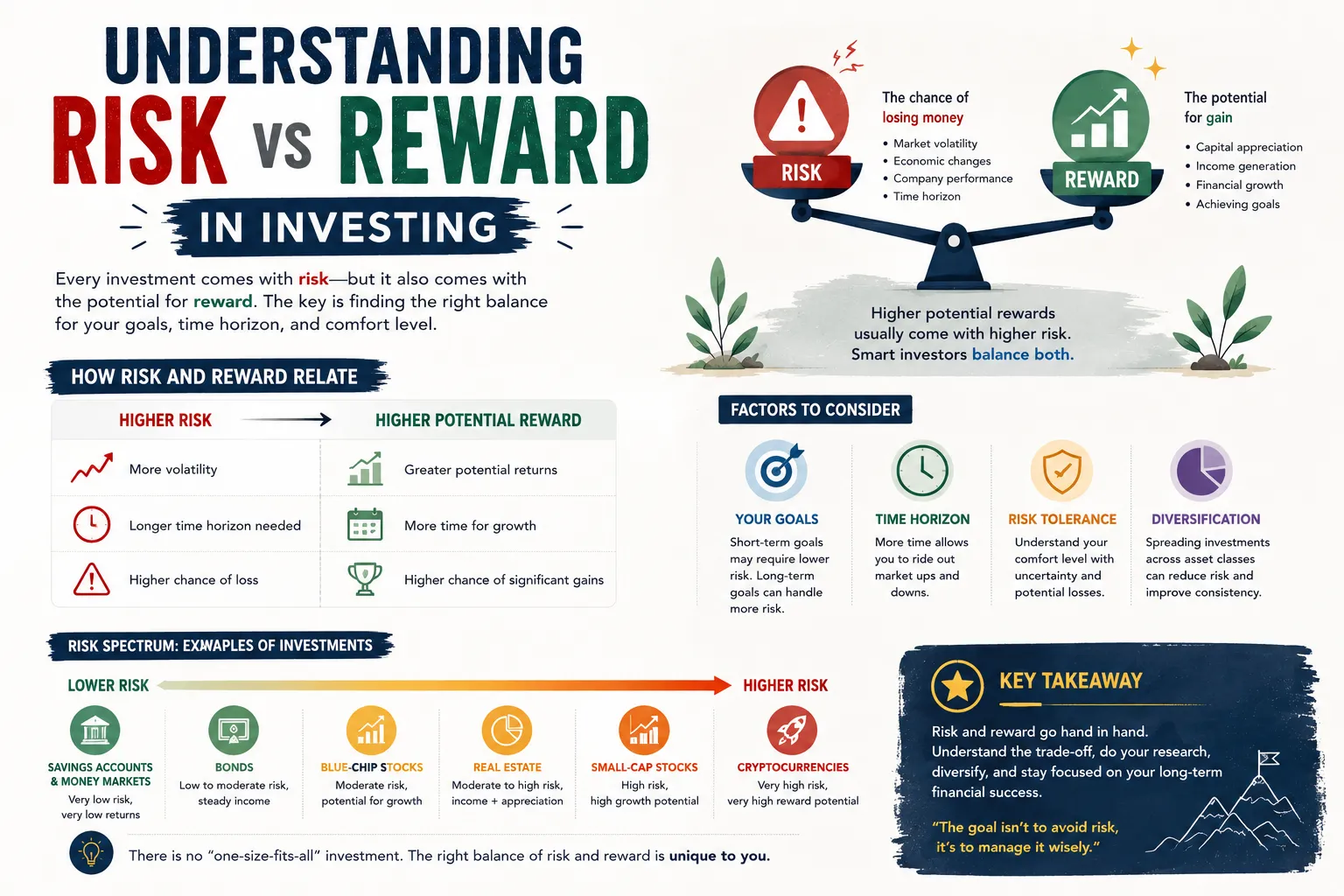
Every successful investor eventually learns one fundamental principle: higher potential rewards usually come with higher levels of risk. Whether you are investing in stocks, exchange-traded funds (ETFs), real estate, bonds, cryptocurrency, private equity, or dividend-paying assets, understanding the relationship between risk and reward is essential for long-term financial success.
In today's rapidly changing financial environment, investors have more opportunities than ever before. Global markets, AI-driven industries, technology stocks, renewable energy investments, real estate investment trusts (REITs), and alternative assets continue attracting capital from investors seeking strong returns. However, maximizing returns without understanding risk can lead to costly mistakes.
This guide explores risk versus reward in investing, explains different types of investment risks, provides practical portfolio management strategies, and helps investors make informed decisions aligned with their financial goals.
What Does Risk Mean in Investing?
Investment risk refers to the possibility that an investment's actual return will differ from expectations. In some cases, investors may experience lower profits than anticipated. In extreme situations, they may lose a portion or all of their invested capital.
Risk exists because financial markets are influenced by numerous factors, including:
- Economic conditions
- Interest rate changes
- Inflation
- Corporate performance
- Political developments
- Global events
- Technological disruption
- Market sentiment
No investment is entirely risk-free. Even traditionally safe investments can lose purchasing power due to inflation.
What Is Investment Reward?
The reward represents the return an investor earns from an investment. Returns can come from several sources:
- Capital appreciation
- Dividend income
- Interest payments
- Rental income
- Business growth
- Compounding returns
Investors seek rewards because they help achieve important financial objectives such as retirement planning, wealth preservation, passive income generation, education funding, and financial independence.
The Core Principle of Risk vs Reward
The relationship between risk and reward forms the foundation of modern investing.
Generally speaking:
- Low-risk investments offer lower potential returns.
- Moderate-risk investments offer balanced return opportunities.
- High-risk investments may generate substantial gains but can also produce significant losses.
This principle is often referred to as the risk-reward tradeoff.
Investors must evaluate whether the potential reward justifies the level of risk involved.
Risk vs Reward Comparison
| Investment Type | Risk Level | Potential Return | Liquidity |
|---|---|---|---|
| Savings Accounts | Very Low | Low | High |
| Government Bonds | Low | Low to Moderate | High |
| Corporate Bonds | Moderate | Moderate | Medium |
| Dividend Stocks | Moderate | Moderate to High | High |
| Growth Stocks | High | High | High |
| Technology Stocks | High | Very High | High |
| Real Estate | Moderate | Moderate to High | Low |
| REITs | Moderate | Moderate to High | High |
| Cryptocurrency | Very High | Very High | High |
| Private Equity | Very High | Very High | Very Low |
Major Types of Investment Risk
1. Market Risk
Market risk occurs when overall financial markets decline. Economic recessions, geopolitical conflicts, and interest rate changes can negatively impact market performance.
2. Inflation Risk
Inflation reduces purchasing power over time. Investors earning low returns may find their investments failing to keep pace with rising living costs.
3. Interest Rate Risk
Bond prices often move inversely to interest rates. Rising rates can reduce the value of existing fixed-income investments.
4. Liquidity Risk
Some assets are difficult to sell quickly without accepting a lower price. Real estate and private investments commonly face liquidity challenges.
5. Credit Risk
Credit risk refers to the possibility that a borrower or bond issuer may default on obligations.
6. Concentration Risk
Investing too heavily in one stock, industry, or asset class increases vulnerability to sector-specific downturns.
7. Currency Risk
International investments may experience gains or losses due to exchange rate fluctuations.
Understanding Your Risk Tolerance
Every investor has a different level of comfort with risk. Determining risk tolerance helps build a suitable investment strategy.
Factors affecting risk tolerance include:
- Age
- Income stability
- Financial goals
- Investment experience
- Time horizon
- Current assets and liabilities
- Psychological comfort with volatility
Conservative Investors
Conservative investors prioritize capital preservation and prefer lower-risk investments such as bonds, dividend stocks, and high-quality ETFs.
Moderate Investors
Moderate investors seek balanced growth while maintaining manageable risk exposure.
Aggressive Investors
Aggressive investors focus on maximizing long-term returns and can tolerate significant short-term volatility.
Why Time Horizon Matters
The length of time before funds are needed significantly influences investment decisions.
Longer investment horizons generally allow investors to accept greater short-term volatility because markets historically recover over time.
| Time Horizon | Suggested Risk Profile |
|---|---|
| 0-3 Years | Conservative |
| 3-7 Years | Moderate |
| 7-15 Years | Growth Focused |
| 15+ Years | Aggressive Growth |
The Power of Diversification
Diversification remains one of the most effective methods for reducing portfolio risk.
Instead of relying on a single investment, diversified portfolios spread assets across multiple categories.
Diversification may include:
- Domestic stocks
- International stocks
- Bonds
- Real estate
- REITs
- Commodities
- Alternative investments
- Cash reserves
A diversified portfolio can reduce the impact of poor performance from any single asset class.
Asset Allocation Strategies
Asset allocation determines how investments are distributed among different asset categories.
Conservative Portfolio
| Asset | Allocation |
|---|---|
| Bonds | 60% |
| Stocks | 30% |
| Cash | 10% |
Balanced Portfolio
| Asset | Allocation |
|---|---|
| Stocks | 60% |
| Bonds | 30% |
| Alternatives | 10% |
Growth Portfolio
| Asset | Allocation |
|---|---|
| Stocks | 80% |
| Alternatives | 15% |
| Cash | 5% |
Risk Management Techniques Used by Successful Investors
Professional investors employ numerous strategies to manage risk while pursuing attractive returns.
Regular Portfolio Rebalancing
Rebalancing restores target asset allocations and prevents overexposure to high-performing sectors.
Dollar-Cost Averaging
Investing fixed amounts at regular intervals reduces timing risk and helps smooth market volatility.
Emergency Funds
Maintaining cash reserves reduces the need to liquidate investments during market downturns.
Quality Investments
Strong companies with sustainable competitive advantages often demonstrate greater resilience during economic uncertainty.
Long-Term Perspective
Many investors underperform due to emotional decision-making. Long-term investing helps avoid panic selling.
Common Investing Mistakes Related to Risk
Chasing Returns
Investors frequently buy assets after large price increases without evaluating underlying risks.
Ignoring Diversification
Overconcentration can create substantial losses when individual investments underperform.
Emotional Investing
Fear and greed often lead to poor investment decisions.
Underestimating Inflation
Preserving purchasing power is essential for long-term wealth growth.
Lack of Research
Investment decisions should be based on thorough analysis rather than speculation.
Risk vs Reward Across Popular Asset Classes
Stocks
Stocks offer strong long-term growth potential but can experience significant volatility.
ETFs
Exchange-traded funds provide diversification and often reduce company-specific risk.
Real Estate
Real estate can generate rental income, appreciation, and inflation protection.
Bonds
Bonds generally provide lower returns but offer portfolio stability.
Cryptocurrency
Digital assets may provide extraordinary returns but involve substantial volatility and regulatory uncertainty.
Alternative Investments
Private equity, venture capital, hedge funds, and commodities can diversify portfolios but often require specialized knowledge.
How Economic Cycles Influence Risk and Reward
Economic cycles affect investment performance significantly.
- Expansion periods often favor stocks.
- Rising interest rate environments impact bonds differently.
- Inflationary periods may benefit commodities and real assets.
- Recessions typically increase market volatility.
Understanding macroeconomic conditions helps investors make more informed decisions.
Building a Personalized Investment Strategy
A successful investment strategy balances return objectives with acceptable risk levels.
The process typically involves:
- Defining financial goals.
- Assessing risk tolerance.
- Determining investment timeline.
- Selecting appropriate asset classes.
- Diversifying investments.
- Monitoring performance.
- Rebalancing periodically.
Investors who follow structured plans often achieve more consistent long-term results than those reacting emotionally to market movements.
The Psychology of Risk
Behavioral finance research shows that investors often feel losses more intensely than gains. This phenomenon, known as loss aversion, can lead to irrational decisions during market volatility.
Developing emotional discipline is just as important as selecting quality investments. Successful investors focus on long-term objectives rather than short-term market noise.
Future Investment Opportunities in 2026 and Beyond
Several sectors continue attracting investor attention because of their long-term growth potential:
- Artificial Intelligence
- Cloud Computing
- Cybersecurity
- Renewable Energy
- Healthcare Technology
- Financial Technology
- Semiconductor Manufacturing
- Data Infrastructure
- Automation and Robotics
- Digital Payments
While these sectors may offer attractive returns, investors should carefully evaluate valuation levels, competition, and market risks before investing.
Final Thoughts
Understanding risk versus reward is one of the most important skills any investor can develop. Every investment decision involves tradeoffs, and there is rarely a path to high returns without accepting some level of uncertainty.
The goal is not to eliminate risk entirely but to manage it intelligently. Through diversification, proper asset allocation, disciplined investing, ongoing education, and a long-term perspective, investors can position themselves to pursue meaningful returns while controlling unnecessary exposure.
Whether you are building a retirement portfolio, creating passive income streams, investing in growth opportunities, or preserving wealth for future generations, understanding the balance between risk and reward provides the foundation for making informed financial decisions and achieving long-term investment success.