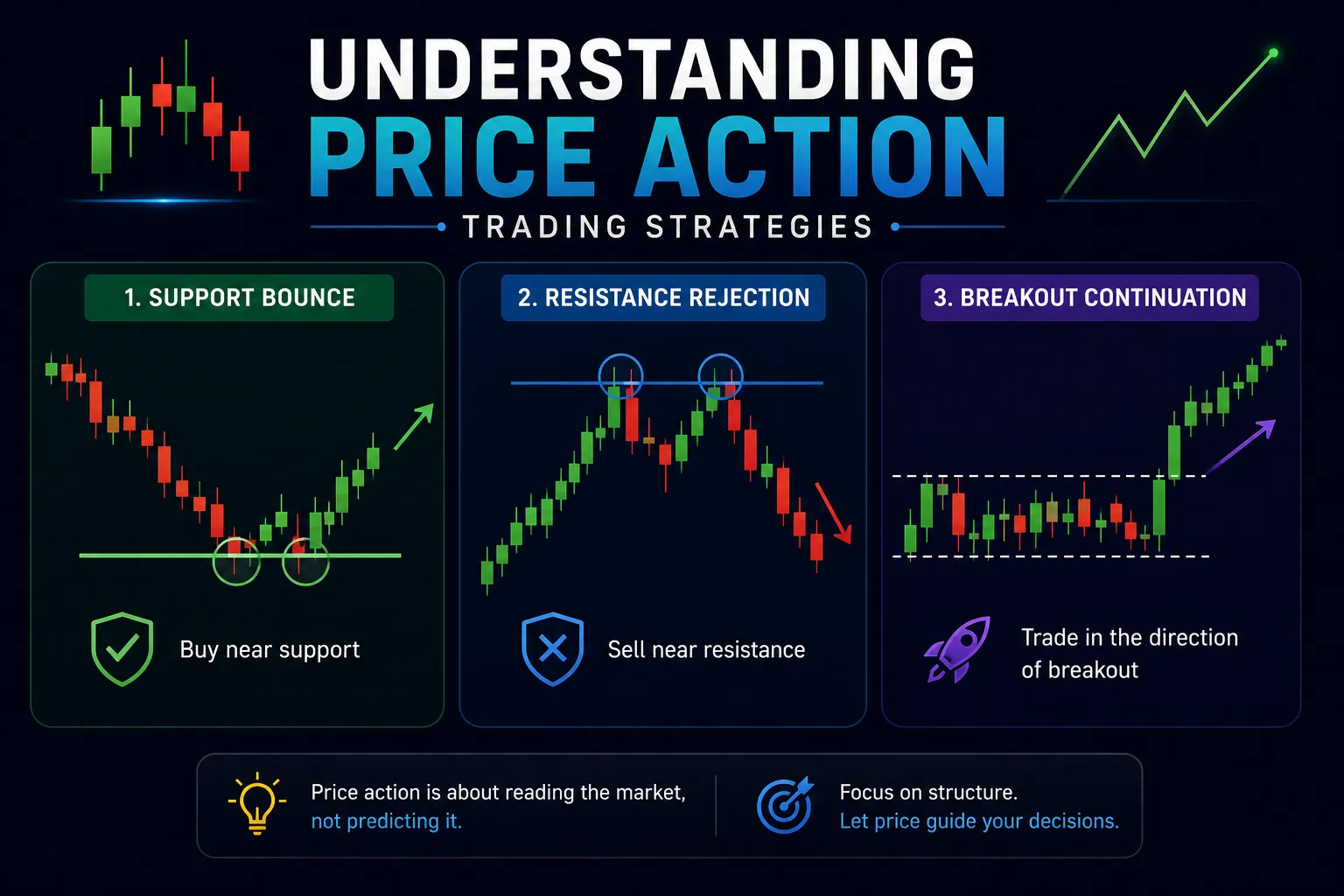
Understanding Price Action Trading Strategies
Price action trading is one of the most respected and widely used approaches in modern financial markets. Unlike indicator-heavy trading systems that rely on complex calculations, price action trading focuses primarily on interpreting raw market movements directly from price charts. Professional traders, institutional investors, hedge funds, and experienced retail traders often use price action techniques because they provide a clear view of market behavior without excessive complexity.
Whether trading stocks, exchange-traded funds (ETFs), forex pairs, futures contracts, options, commodities, or cryptocurrencies, price action remains one of the most versatile trading methodologies available. By studying how prices move, traders can identify trends, recognize market sentiment, evaluate risk, and make informed decisions based on supply and demand dynamics.
In today's markets, where artificial intelligence, algorithmic trading, and high-frequency trading systems dominate significant portions of market activity, price action remains highly relevant because every market participant ultimately influences price movement. Understanding how to read and interpret price behavior can provide traders with a valuable edge.
This comprehensive guide explains price action trading strategies, core concepts, market structure analysis, candlestick patterns, support and resistance, risk management principles, and practical applications for modern traders.
What Is Price Action Trading?
Price action trading is the practice of making trading decisions based primarily on historical and current price movements rather than relying heavily on technical indicators.
Price action traders focus on:
- Market structure
- Candlestick formations
- Support and resistance levels
- Trend behavior
- Breakout patterns
- Volume confirmation
- Market sentiment
The philosophy behind price action trading is simple: price reflects all available information and therefore provides the most direct representation of market conditions.
| Approach | Primary Focus |
|---|---|
| Price Action Trading | Raw Price Movement |
| Indicator Trading | Mathematical Calculations |
| Fundamental Analysis | Economic and Company Data |
Why Price Action Trading Is Popular
Many traders prefer price action because it offers simplicity, flexibility, and adaptability across different market environments.
Key advantages include:
- Works across multiple asset classes
- Reduces chart clutter
- Improves market understanding
- Enhances risk management
- Provides real-time market insights
- Adaptable to various timeframes
Price action strategies can be applied by day traders, swing traders, position traders, and long-term investors.
Understanding Market Structure
Market structure is the foundation of price action trading.
Every market moves through identifiable phases that help traders understand trend direction.
Uptrend
An uptrend consists of higher highs and higher lows.
This indicates strong buying pressure and positive market sentiment.
Downtrend
A downtrend consists of lower highs and lower lows.
This signals increasing selling pressure.
Range-Bound Market
When prices move sideways between support and resistance, markets are considered range-bound.
| Market Structure | Characteristics |
|---|---|
| Uptrend | Higher Highs, Higher Lows |
| Downtrend | Lower Highs, Lower Lows |
| Range | Sideways Movement |
Support and Resistance in Price Action Trading
Support and resistance are among the most important concepts in price action analysis.
Support
Support represents a price area where buying pressure historically exceeds selling pressure.
Prices often stabilize or reverse upward at support zones.
Resistance
Resistance represents a price area where selling pressure tends to overcome buying demand.
Prices frequently stall or reverse downward at resistance levels.
Professional traders often view support and resistance as zones rather than exact prices.
The Psychology Behind Price Action
Price action reflects collective market psychology.
Every price movement results from interactions between buyers and sellers.
Common psychological influences include:
- Fear
- Greed
- Optimism
- Pessimism
- Institutional positioning
- Retail trader behavior
Understanding market psychology helps traders interpret price movements more effectively.
Candlestick Patterns Explained
Candlestick charts are among the most powerful tools used in price action analysis.
Each candlestick displays:
- Opening price
- Closing price
- Highest price
- Lowest price
This information provides valuable insight into market sentiment.
Hammer Pattern
A hammer often appears near support levels and may indicate bullish reversal potential.
Shooting Star
A shooting star often forms near resistance and can suggest bearish reversal conditions.
Bullish Engulfing
This pattern occurs when a large bullish candle fully engulfs the previous bearish candle.
Bearish Engulfing
This pattern occurs when a bearish candle completely engulfs the prior bullish candle.
| Pattern | Potential Signal |
|---|---|
| Hammer | Bullish Reversal |
| Shooting Star | Bearish Reversal |
| Bullish Engulfing | Buying Momentum |
| Bearish Engulfing | Selling Momentum |
| Doji | Market Indecision |
Trend Following Price Action Strategies
Trend-following remains one of the most popular price action approaches.
Core principle:
Trade with the dominant trend whenever possible.
Buying Pullbacks
In an uptrend, traders often wait for temporary price declines before entering long positions.
Selling Retracements
In a downtrend, traders may sell rallies into resistance.
Trend-following helps traders align with prevailing market momentum.
Breakout Trading Strategies
Breakouts occur when prices move beyond established support or resistance levels.
Bullish Breakout
Occurs when prices move above resistance.
Potential implications include:
- New buyers entering the market
- Short covering activity
- Momentum acceleration
Bearish Breakdown
Occurs when prices fall below support.
This may signal increased selling pressure.
| Breakout Type | Potential Interpretation |
|---|---|
| Bullish Breakout | Upward Momentum |
| Bearish Breakdown | Downward Momentum |
False Breakouts
Not all breakouts succeed.
False breakouts occur when prices briefly move beyond a level before reversing.
Common causes include:
- Low volume
- Liquidity hunting
- Institutional positioning
- Weak market participation
Many professional traders wait for confirmation before entering breakout trades.
Price Action and Volume Analysis
Volume provides additional context for price movements.
Strong volume often confirms:
- Trend continuation
- Breakout validity
- Institutional participation
- Market conviction
| Price Action Event | Volume Interpretation |
|---|---|
| Breakout With High Volume | Strong Confirmation |
| Breakout With Low Volume | Potential Failure Risk |
| Support Bounce With Volume | Strong Buying Interest |
| Resistance Rejection With Volume | Strong Selling Pressure |
Multi-Timeframe Analysis
Professional traders frequently analyze multiple timeframes.
Example approach:
- Weekly chart for long-term trend
- Daily chart for setup identification
- 4-hour chart for trade entries
This approach improves overall market perspective.
Price Action Trading in Different Markets
Stock Markets
Price action helps identify accumulation, distribution, breakouts, and trend continuation opportunities.
Forex Markets
Forex traders heavily rely on price action due to the technical nature of currency markets.
Cryptocurrency Markets
Digital asset traders frequently use price action because crypto markets often exhibit strong momentum and volatility.
Options Trading
Price action assists options traders in timing entries and exits more effectively.
Risk Management for Price Action Traders
Risk management remains more important than any trading strategy.
Successful traders focus on preserving capital.
Stop Loss Placement
Common stop locations include:
- Below support
- Above resistance
- Beyond swing highs
- Beyond swing lows
Position Sizing
Position size should align with overall portfolio risk tolerance.
| Risk Management Tool | Purpose |
|---|---|
| Stop Loss | Limit Losses |
| Position Sizing | Control Exposure |
| Risk-Reward Ratio | Improve Profitability |
| Diversification | Reduce Concentration Risk |
Common Price Action Trading Mistakes
- Ignoring market context
- Trading every candlestick pattern
- Overtrading
- Ignoring risk management
- Using excessive leverage
- Chasing breakouts without confirmation
- Trading against dominant trends
A disciplined approach helps traders avoid these common pitfalls.
Institutional Trading and Price Action
Institutional investors often influence major market movements.
Large market participants monitor:
- Liquidity zones
- Support and resistance levels
- Volume profiles
- Trend structures
- Market sentiment
Understanding institutional behavior can enhance price action analysis.
Price Action in Modern Algorithmic Markets
Modern financial markets include:
- Algorithmic trading systems
- Artificial intelligence models
- Machine learning applications
- High-frequency trading firms
Despite these technological advances, price action remains highly relevant because all market activity ultimately influences price itself.
Building a Complete Price Action Trading Plan
A professional trading plan should include:
- Market selection
- Trend analysis rules
- Entry criteria
- Exit criteria
- Risk management guidelines
- Position sizing framework
- Performance review process
Consistency often matters more than finding a perfect strategy.
Final Thoughts
Price action trading provides a powerful framework for understanding financial markets by focusing directly on price behavior rather than relying exclusively on indicators. Through market structure analysis, candlestick interpretation, support and resistance identification, trend recognition, and disciplined risk management, traders can develop a deeper understanding of market dynamics.
Whether trading stocks, forex, ETFs, options, futures, commodities, or cryptocurrencies, price action principles remain universally applicable. While no strategy guarantees success, learning to read and interpret price movements can help traders make more informed decisions, improve discipline, and navigate modern markets with greater confidence.
Ultimately, successful price action trading is not about predicting every market move. It is about recognizing high-probability opportunities, managing risk effectively, and consistently applying proven principles over the long term.