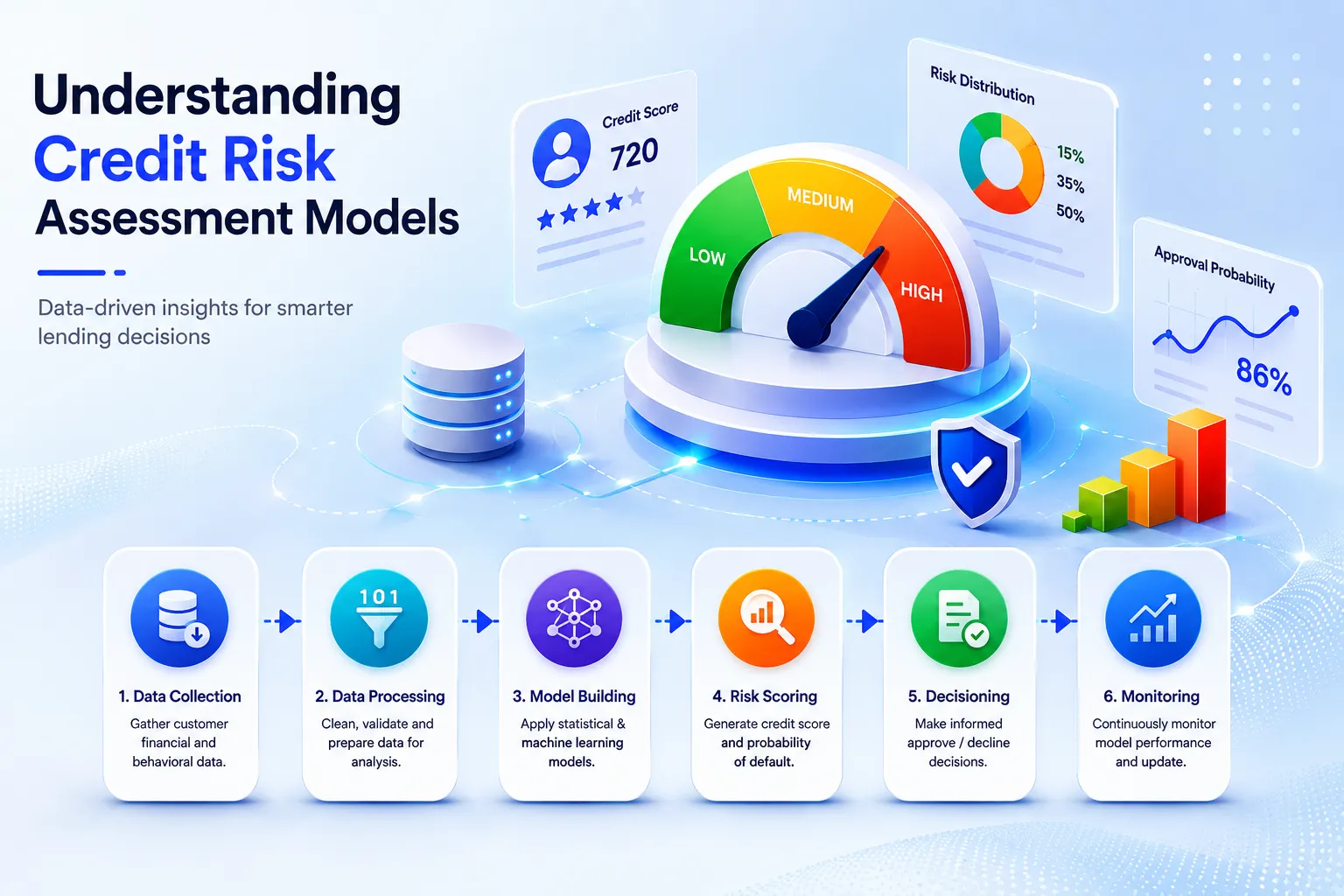
Understanding Credit Risk Assessment Models
Credit risk assessment is one of the most critical functions within modern banking, lending, financial services, and investment management. Every time a bank approves a mortgage, a fintech platform issues a personal loan, a credit card provider extends a credit limit, or a commercial lender finances a business expansion, sophisticated credit risk assessment models are used to evaluate the probability that the borrower will repay their obligations.
As global lending markets continue expanding, financial institutions increasingly rely on advanced analytics, artificial intelligence, machine learning, alternative data sources, and predictive modeling to improve credit decisions. Modern credit risk assessment models help lenders reduce losses, improve profitability, maintain regulatory compliance, and provide financing opportunities to qualified borrowers.
In today's highly competitive financial environment, accurate credit risk modeling has become a strategic advantage. Institutions that effectively assess borrower risk can optimize lending portfolios, improve capital allocation, reduce default rates, and enhance long-term financial stability.
This comprehensive guide explains how credit risk assessment models work, the methodologies used by lenders, key risk metrics, modern underwriting technologies, regulatory considerations, and future trends shaping credit evaluation worldwide.
What Is Credit Risk?
Credit risk refers to the possibility that a borrower will fail to meet financial obligations according to agreed terms.
Financial institutions face credit risk whenever they provide:
- Personal loans
- Mortgages
- Business loans
- Credit cards
- Commercial financing
- Corporate bonds
- Trade credit
The primary goal of credit risk assessment is to estimate the likelihood of default and determine whether lending is financially appropriate.
| Credit Product | Associated Risk |
|---|---|
| Mortgage Loan | Property Payment Default |
| Credit Card | Unsecured Debt Risk |
| Business Loan | Business Cash Flow Risk |
| Auto Loan | Consumer Repayment Risk |
| Commercial Credit | Corporate Financial Risk |
Why Credit Risk Assessment Matters
Without effective risk assessment, lenders would face significant financial losses and increased uncertainty.
Credit risk models help organizations:
- Reduce default rates
- Improve lending profitability
- Enhance underwriting accuracy
- Support regulatory compliance
- Optimize capital allocation
- Improve portfolio performance
- Strengthen financial stability
Accurate risk evaluation benefits both lenders and borrowers by supporting sustainable lending decisions.
The Evolution of Credit Risk Models
Credit assessment has evolved considerably over time.
Historically, lending decisions relied heavily on personal relationships and manual reviews. Today, institutions utilize sophisticated analytical frameworks capable of evaluating thousands of variables simultaneously.
Modern developments include:
- Statistical credit scoring
- Predictive analytics
- Machine learning algorithms
- Alternative data integration
- Real-time risk monitoring
- AI-powered underwriting systems
Core Components of Credit Risk Assessment
Most credit risk models evaluate several key dimensions.
Payment History
Past repayment behavior often serves as one of the strongest indicators of future performance.
Income and Cash Flow
Borrowers must demonstrate sufficient financial resources to service debt obligations.
Debt Levels
Existing liabilities influence repayment capacity.
Credit Utilization
High utilization rates may indicate increased financial stress.
Employment Stability
Stable employment often correlates with improved repayment reliability.
| Assessment Factor | Purpose |
|---|---|
| Payment History | Evaluate Past Reliability |
| Income | Measure Repayment Capacity |
| Debt Ratio | Assess Financial Leverage |
| Employment | Estimate Stability |
| Credit Utilization | Identify Risk Signals |
Traditional Credit Scoring Models
Traditional credit scoring systems assign numerical scores representing borrower risk levels.
These scores help lenders:
- Standardize underwriting decisions
- Improve efficiency
- Reduce subjectivity
- Support portfolio management
Higher scores generally indicate lower credit risk, while lower scores suggest elevated default probabilities.
Probability of Default (PD)
Probability of Default is one of the most important concepts in credit risk management.
PD estimates the likelihood that a borrower will default within a specified timeframe.
Financial institutions use PD calculations to:
- Price loans
- Allocate capital
- Determine reserves
- Manage portfolios
Loss Given Default (LGD)
Loss Given Default estimates the percentage of exposure that may be lost if a borrower defaults.
Factors affecting LGD include:
- Collateral value
- Recovery rates
- Legal costs
- Market conditions
Exposure at Default (EAD)
Exposure at Default represents the total amount outstanding when a default occurs.
Lenders use EAD calculations to estimate potential financial losses.
| Risk Metric | Definition |
|---|---|
| PD | Probability of Default |
| LGD | Loss Given Default |
| EAD | Exposure at Default |
| Expected Loss | Projected Credit Loss |
Risk-Based Lending and Pricing
Modern lenders increasingly use risk-based pricing models.
Under this approach:
- Lower-risk borrowers receive better rates.
- Higher-risk borrowers may pay higher interest rates.
- Loan structures reflect projected risk levels.
This methodology helps align lending profitability with expected losses.
Commercial Credit Risk Assessment
Business lending requires additional analysis beyond consumer credit scores.
Commercial credit evaluation often includes:
- Financial statement analysis
- Cash flow projections
- Industry risk assessment
- Management quality evaluation
- Market competitiveness analysis
Commercial lenders must understand both borrower-specific and industry-wide risks.
Financial Ratios Used in Credit Analysis
Credit analysts commonly evaluate financial ratios when assessing borrowers.
| Ratio | Purpose |
|---|---|
| Debt-to-Income Ratio | Measure Debt Burden |
| Interest Coverage Ratio | Assess Payment Capacity |
| Current Ratio | Evaluate Liquidity |
| Debt-to-Equity Ratio | Measure Financial Leverage |
| Cash Flow Coverage Ratio | Analyze Repayment Ability |
Artificial Intelligence in Credit Assessment
Artificial intelligence is reshaping credit evaluation.
AI systems can analyze vast datasets and identify patterns beyond traditional underwriting methods.
Applications include:
- Automated loan approvals
- Fraud detection
- Risk prediction
- Portfolio monitoring
- Behavioral analytics
AI-driven systems improve efficiency while supporting more accurate decision-making.
Machine Learning Credit Models
Machine learning algorithms continuously improve as additional data becomes available.
Benefits include:
- Enhanced predictive accuracy
- Adaptive risk assessment
- Improved fraud detection
- Faster underwriting decisions
- Greater scalability
Many fintech lenders now rely heavily on machine learning-based underwriting systems.
Alternative Data Sources
Traditional credit reports do not always provide complete borrower profiles.
Alternative data sources may include:
- Utility payment histories
- Rental payment records
- Bank transaction data
- Business accounting data
- Digital financial behavior
Alternative data can improve financial inclusion by helping lenders evaluate borrowers with limited credit histories.
Fraud Detection and Risk Prevention
Fraud prevention is an important component of credit risk management.
Modern systems monitor:
- Identity verification
- Transaction anomalies
- Application inconsistencies
- Behavioral patterns
Advanced analytics help reduce financial losses resulting from fraudulent activity.
Regulatory Requirements for Credit Risk Management
Financial institutions operate within complex regulatory frameworks.
Regulatory objectives include:
- Consumer protection
- Financial stability
- Prudent lending standards
- Capital adequacy requirements
- Risk transparency
Compliance plays a central role in modern credit risk programs.
Portfolio Credit Risk Management
Credit risk assessment extends beyond individual borrowers.
Portfolio-level analysis helps institutions:
- Diversify exposure
- Monitor concentration risks
- Evaluate sector performance
- Manage economic cycle impacts
- Improve capital planning
Effective portfolio management reduces systemic lending risks.
| Portfolio Risk Factor | Impact |
|---|---|
| Industry Concentration | Sector Exposure Risk |
| Geographic Concentration | Regional Economic Risk |
| Borrower Size | Single Exposure Risk |
| Economic Conditions | Default Cycle Risk |
Challenges in Credit Risk Modeling
Despite technological advances, credit risk assessment remains challenging.
Common issues include:
- Economic uncertainty
- Incomplete data
- Changing borrower behavior
- Model bias concerns
- Regulatory complexity
- Cybersecurity risks
Continuous model validation helps institutions maintain accuracy.
Future Trends in Credit Risk Assessment
Several innovations are expected to shape the future of credit analysis.
- Artificial intelligence expansion
- Real-time underwriting
- Open banking integration
- Behavioral finance analytics
- Cloud-based risk platforms
- Advanced predictive modeling
- Alternative credit scoring systems
These developments may improve both lending efficiency and borrower access to capital.
Benefits for Borrowers and Lenders
Well-designed credit risk models create value for all stakeholders.
| Stakeholder | Primary Benefit |
|---|---|
| Lenders | Reduced Losses |
| Borrowers | Fairer Loan Decisions |
| Investors | Improved Portfolio Stability |
| Regulators | Financial System Resilience |
Final Thoughts
Credit risk assessment models serve as the foundation of modern lending and financial risk management. By combining traditional credit analysis, statistical modeling, artificial intelligence, machine learning, alternative data, and predictive analytics, financial institutions can make more informed lending decisions while managing risk effectively.
As digital banking, fintech innovation, open banking ecosystems, and AI-powered underwriting continue evolving, credit risk assessment will become increasingly sophisticated. Institutions that successfully leverage advanced risk models can improve profitability, enhance customer experiences, strengthen portfolio performance, and maintain long-term financial stability.
For lenders, investors, business owners, and financial professionals, understanding credit risk assessment models is essential for navigating today’s increasingly data-driven financial landscape. As technology continues transforming the industry, accurate and responsible credit evaluation will remain a critical pillar of sustainable economic growth.