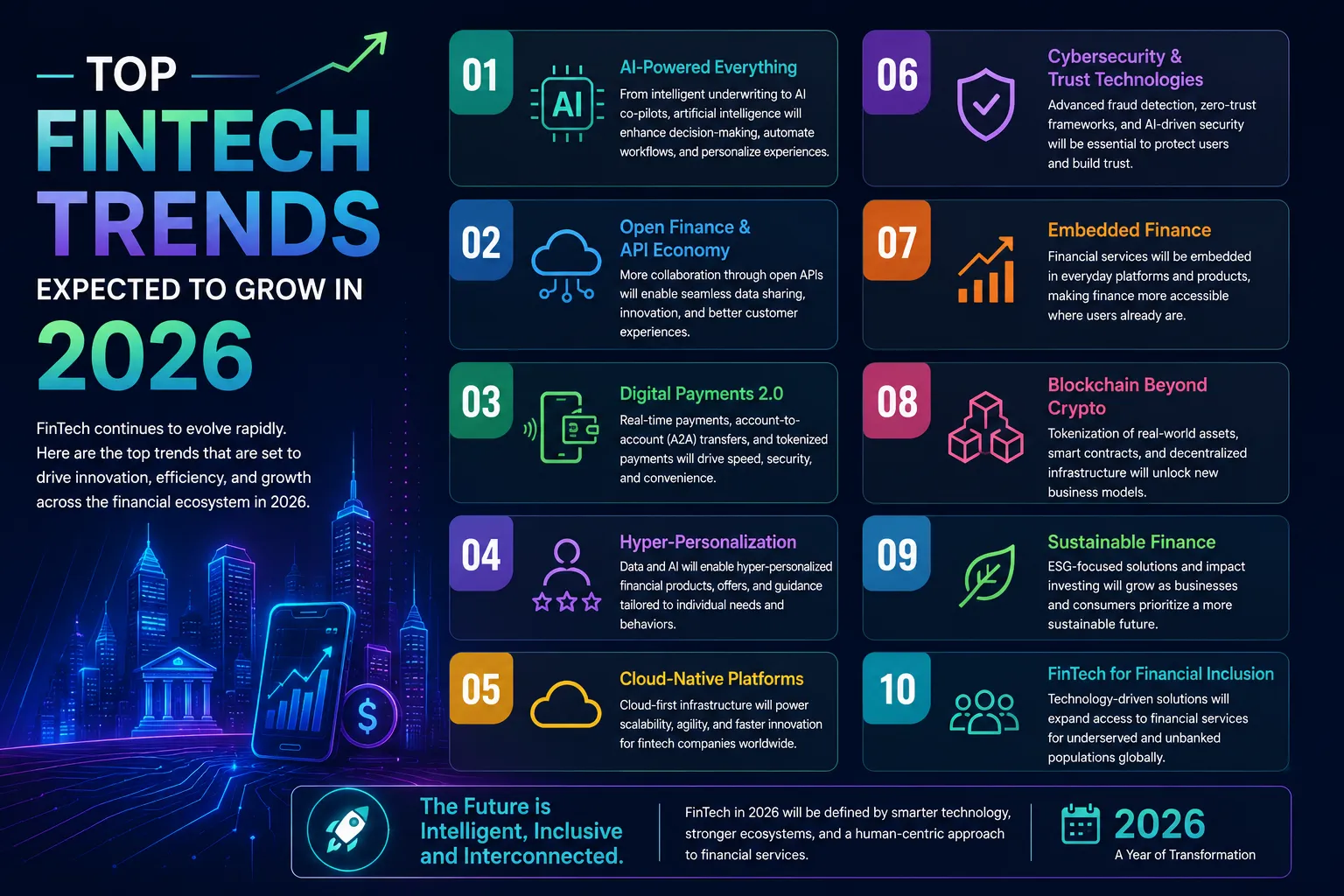
Top FinTech Trends Expected to Grow in 2026
The financial technology industry continues to reshape global financial services at an unprecedented pace. Over the past decade, fintech companies have transformed how consumers and businesses manage money, access credit, invest assets, process payments, and interact with financial institutions. As technology advances and customer expectations evolve, 2026 is expected to become another pivotal year for fintech innovation.
Artificial intelligence, embedded finance, digital banking, open banking ecosystems, blockchain infrastructure, financial automation, and next-generation payment technologies are creating entirely new business models across the financial sector. Financial institutions, startups, investors, and enterprises are increasingly focusing on scalable fintech solutions that improve efficiency, enhance customer experiences, reduce operational costs, and generate new revenue opportunities.
Global demand for digital financial services continues growing across both developed and emerging markets. Consumers now expect instant transactions, personalized financial products, mobile-first experiences, advanced security, and seamless integration between financial services and digital platforms.
This comprehensive guide explores the most important fintech trends expected to drive growth, innovation, and investment opportunities throughout 2026 and beyond.
The Evolution of Financial Technology
Financial technology has evolved from simple online banking tools into a sophisticated ecosystem of interconnected digital services.
Modern fintech solutions span:
- Digital banking
- Payment processing
- Wealth management
- Lending platforms
- Insurance technology
- Blockchain infrastructure
- Financial analytics
- Regulatory technology
The next phase of fintech growth will be defined by intelligence, automation, personalization, and ecosystem integration.
| FinTech Segment | Growth Driver | 2026 Outlook |
|---|---|---|
| Digital Banking | Customer Demand | Strong Growth |
| AI Finance | Automation | Very Strong Growth |
| Embedded Finance | E-Commerce Expansion | Rapid Adoption |
| WealthTech | Investment Accessibility | High Growth |
| Cybersecurity | Risk Management | Critical Priority |
Artificial Intelligence Becomes Core Financial Infrastructure
Artificial intelligence is expected to become one of the most transformative forces in financial services during 2026.
Financial institutions are increasingly deploying AI across:
- Fraud detection
- Credit underwriting
- Customer service
- Risk management
- Investment analysis
- Compliance monitoring
Machine learning algorithms allow organizations to process vast amounts of financial data while generating actionable insights in real time.
Generative AI for Financial Services
Generative AI is rapidly moving beyond experimentation into enterprise adoption.
Key applications include:
- Automated financial reporting
- Research summarization
- Customer communication
- Regulatory documentation
- Knowledge management
- Financial planning assistance
Organizations investing early in generative AI capabilities are likely to gain significant productivity advantages.
Embedded Finance Expansion
Embedded finance continues emerging as one of the fastest-growing fintech sectors.
Rather than requiring customers to visit traditional financial institutions, embedded finance integrates banking services directly into non-financial platforms.
Examples include:
- Buy now pay later solutions
- Embedded lending
- Integrated insurance
- Merchant financing
- In-app payment systems
Businesses increasingly view financial services as strategic features that enhance customer engagement and generate additional revenue streams.
Open Banking Ecosystems
Open banking is transforming financial services through secure API-driven data sharing.
Benefits include:
- Improved personalization
- Enhanced competition
- Faster innovation
- Expanded financial ecosystems
- Better customer experiences
As regulatory frameworks mature, open banking adoption is expected to accelerate globally.
| Open Banking Benefit | Business Impact |
|---|---|
| API Connectivity | Innovation Growth |
| Data Sharing | Personalization |
| Third-Party Integration | Expanded Services |
| Customer Control | Trust Enhancement |
Real-Time Payments Become Standard
Consumers and businesses increasingly expect instant access to funds.
Real-time payment networks are becoming essential infrastructure for modern economies.
Advantages include:
- Immediate settlement
- 24/7 availability
- Improved cash flow
- Enhanced customer satisfaction
- Reduced payment friction
Payment modernization initiatives worldwide continue driving adoption.
Digital Wallet Growth
Digital wallets are becoming central components of everyday financial activity.
Modern wallets support:
- Contactless payments
- Peer-to-peer transfers
- Loyalty programs
- Digital identity verification
- Investment integrations
As smartphone adoption increases, digital wallets are expected to capture a growing share of global transactions.
WealthTech Innovation
Wealth technology platforms continue democratizing access to investment management.
WealthTech solutions include:
- Robo-advisors
- Automated portfolio management
- Goal-based investing
- AI-driven investment analysis
- Digital financial planning
These platforms make sophisticated financial services accessible to broader audiences.
Digital Lending Transformation
Lending technology remains a major fintech growth area.
Modern lending platforms leverage:
- Artificial intelligence
- Alternative credit data
- Automated underwriting
- Predictive analytics
- Real-time decision engines
These innovations improve efficiency while expanding access to credit.
RegTech and Compliance Automation
Regulatory compliance costs continue rising across the financial sector.
RegTech solutions help institutions:
- Monitor transactions
- Detect suspicious activity
- Generate reports
- Track regulatory changes
- Manage compliance workflows
Automation helps reduce costs while improving accuracy and regulatory readiness.
| RegTech Capability | Operational Benefit |
|---|---|
| Transaction Monitoring | Risk Reduction |
| AML Screening | Compliance Enhancement |
| Reporting Automation | Efficiency Gains |
| Risk Analytics | Better Oversight |
FinTech Cybersecurity Investments
As digital financial services expand, cybersecurity becomes increasingly important.
Key areas of investment include:
- Fraud prevention systems
- Behavioral analytics
- Identity verification
- Zero-trust architectures
- AI-powered threat detection
Security innovation is expected to remain one of the highest-funded fintech categories.
Cloud-Native Financial Platforms
Cloud computing continues driving fintech scalability and innovation.
Benefits include:
- Reduced infrastructure costs
- Improved agility
- Faster deployment cycles
- Enhanced resilience
- Global scalability
Cloud-native architectures allow fintech companies to innovate faster while supporting rapid growth.
Blockchain and Digital Asset Infrastructure
Blockchain technology continues evolving beyond cryptocurrency applications.
Financial institutions are exploring:
- Asset tokenization
- Trade finance modernization
- Cross-border settlements
- Smart contracts
- Digital identity solutions
Enterprise blockchain adoption is expected to grow as infrastructure matures.
InsurTech Expansion
Insurance technology remains a rapidly growing segment of fintech.
Innovation areas include:
- Automated underwriting
- Claims processing automation
- Predictive risk assessment
- Usage-based insurance
- AI-powered customer service
Technology is helping insurers improve efficiency while enhancing customer experiences.
Hyper-Personalized Financial Services
Consumers increasingly expect personalized financial experiences.
AI-powered personalization enables:
- Customized product recommendations
- Individualized savings plans
- Personalized lending offers
- Investment guidance
- Financial wellness insights
Personalization is becoming a major competitive differentiator.
Financial Inclusion Through Technology
Fintech continues expanding access to financial services globally.
Digital platforms help underserved populations access:
- Banking services
- Credit products
- Insurance coverage
- Investment opportunities
- Digital payments
Financial inclusion remains a major driver of fintech growth in emerging markets.
Enterprise FinTech Integration
Businesses increasingly integrate fintech solutions directly into operations.
Enterprise use cases include:
- Treasury management
- Accounts payable automation
- Cross-border payments
- Expense management
- Cash flow forecasting
Corporate demand for financial automation is expected to continue growing.
Future Outlook for FinTech in 2026
The fintech industry is entering a new phase characterized by intelligence, automation, interoperability, and customer-centric innovation.
Key themes expected to dominate 2026 include:
- Artificial intelligence at scale
- Embedded financial ecosystems
- Real-time financial infrastructure
- Cloud-native banking platforms
- Advanced cybersecurity solutions
- Open finance frameworks
- Data-driven personalization
Organizations capable of combining technological innovation with regulatory compliance and customer trust will likely emerge as industry leaders.
Conclusion
FinTech innovation continues reshaping the future of global finance. Artificial intelligence, embedded finance, digital payments, open banking, cloud computing, cybersecurity, wealth technology, and automation are expected to drive substantial growth throughout 2026.
Financial institutions, technology companies, investors, and businesses that embrace these emerging trends can unlock significant opportunities for growth, efficiency, customer engagement, and competitive differentiation. As digital transformation accelerates, fintech will remain one of the most influential sectors in the global economy.
The future of finance is becoming more intelligent, connected, personalized, and accessible. Understanding these trends today can help organizations prepare for tomorrow's rapidly evolving financial landscape.