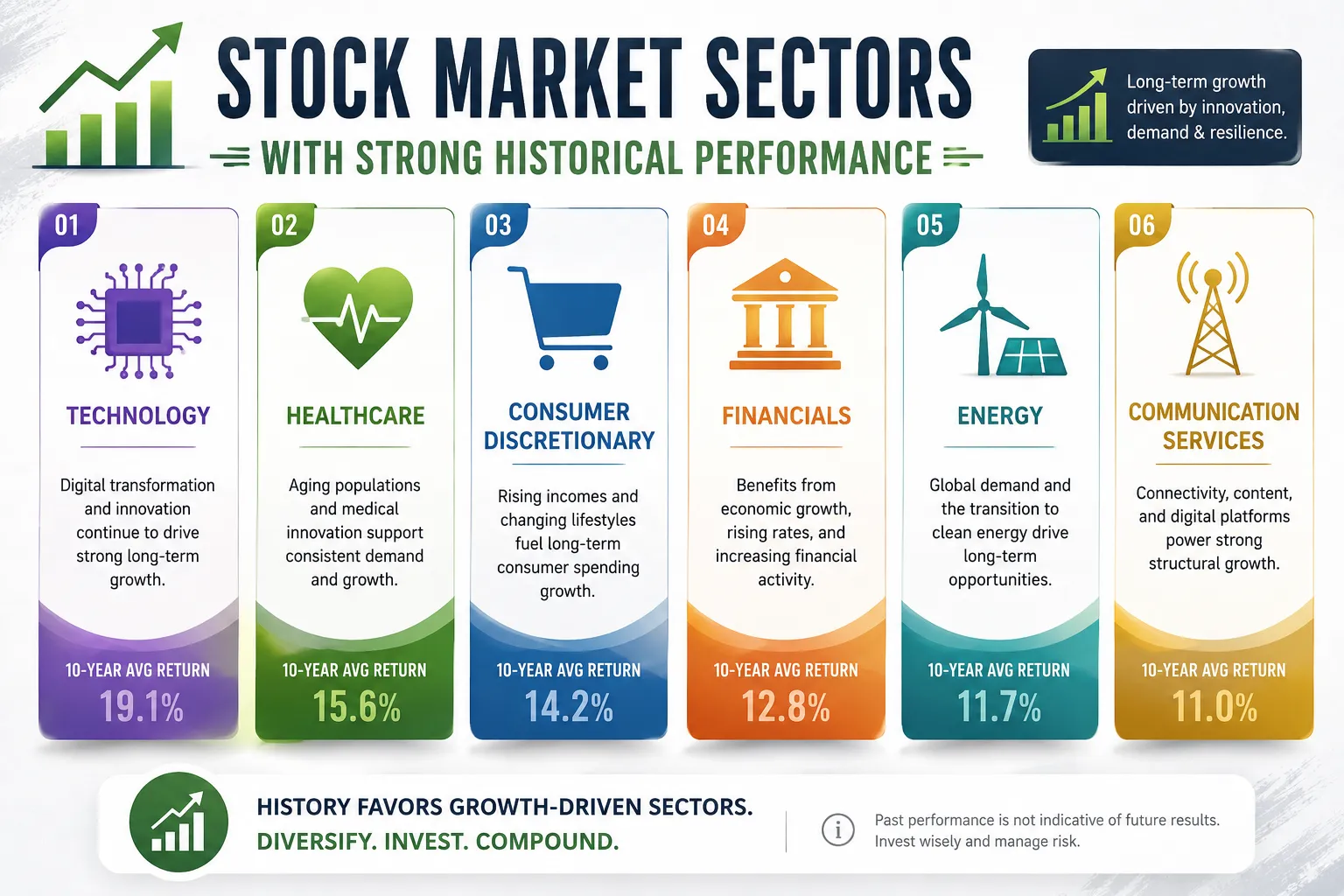
Stock Market Sectors With Strong Historical Performance
The stock market has been one of the most effective wealth-building tools in modern history. While broad market indexes have generated attractive long-term returns, certain sectors have consistently outperformed others due to innovation, economic growth, consumer demand, and technological advancement.
Understanding which stock market sectors have demonstrated strong historical performance can help investors build diversified portfolios, identify long-term opportunities, and improve risk-adjusted returns. Although past performance does not guarantee future results, studying sector performance offers valuable insights into how industries respond to economic cycles, market trends, and global developments.
Today's investors have access to a wide range of sector-focused investment options, including individual stocks, exchange-traded funds (ETFs), mutual funds, index funds, and actively managed portfolios. Sectors such as technology, healthcare, financial services, industrials, consumer discretionary, and emerging innovation industries continue attracting significant institutional and retail investment capital.
This comprehensive guide explores the stock market sectors with the strongest historical performance, examines key growth drivers, discusses risk factors, and explains how investors can incorporate sector investing into long-term wealth-building strategies.
What Is a Stock Market Sector?
A stock market sector is a group of companies that operate within the same area of the economy. Grouping companies by sector helps investors analyze trends, evaluate performance, and diversify portfolios.
Major stock market sectors include:
- Technology
- Healthcare
- Financial Services
- Consumer Discretionary
- Consumer Staples
- Industrials
- Energy
- Utilities
- Real Estate
- Communication Services
- Materials
Each sector responds differently to economic growth, interest rates, inflation, consumer spending, and business investment cycles.
Why Sector Performance Matters
Sector analysis helps investors:
- Identify long-term growth opportunities
- Improve portfolio diversification
- Manage investment risk
- Understand economic trends
- Build sector rotation strategies
- Capture emerging market opportunities
Successful investors often combine sector analysis with fundamental research, technical analysis, and asset allocation planning.
Historical Performance Overview of Major Sectors
| Sector | Historical Growth Potential | Volatility | Income Potential |
|---|---|---|---|
| Technology | Very High | High | Moderate |
| Healthcare | High | Moderate | Moderate |
| Financials | High | Moderate | High |
| Consumer Discretionary | High | Moderate | Moderate |
| Industrials | Moderate-High | Moderate | Moderate |
| Communication Services | High | Moderate | Moderate |
| Energy | Moderate | High | High |
| Consumer Staples | Moderate | Low | High |
| Utilities | Moderate | Low | High |
| Real Estate | Moderate-High | Moderate | High |
Technology Sector: The Long-Term Performance Leader
The technology sector has been one of the strongest-performing sectors over the past several decades. Rapid innovation, digital transformation, cloud computing, artificial intelligence, cybersecurity, software development, and semiconductor advancements have fueled substantial growth.
Key Drivers of Technology Growth
- Artificial Intelligence
- Cloud Computing
- Software-as-a-Service (SaaS)
- Semiconductors
- Cybersecurity
- Digital Payments
- Data Centers
- Automation and Robotics
Technology companies often benefit from scalable business models, recurring revenue streams, and global demand.
Advantages
- Strong earnings growth
- High profit margins
- Innovation-driven expansion
- Global market opportunities
Risks
- Valuation concerns
- Regulatory scrutiny
- Competitive pressures
- Market volatility
Healthcare Sector: Consistent Long-Term Growth
Healthcare has historically delivered strong risk-adjusted returns due to demographic trends, medical innovation, and increasing healthcare demand.
Major healthcare industries include:
- Pharmaceuticals
- Biotechnology
- Medical Devices
- Healthcare Services
- Digital Health Platforms
- Health Insurance Providers
Aging populations and technological advances continue supporting long-term healthcare growth.
| Healthcare Segment | Growth Potential |
|---|---|
| Biotechnology | Very High |
| Medical Devices | High |
| Healthcare Services | Moderate-High |
| Pharmaceuticals | Moderate |
Financial Services Sector
The financial sector plays a central role in economic growth and capital allocation.
Financial companies include:
- Banks
- Insurance Companies
- Investment Firms
- Asset Managers
- Fintech Companies
- Private Equity Firms
Historically, financial stocks have benefited from economic expansion, rising asset values, and increasing financial activity.
Income Opportunities
Many financial institutions pay attractive dividends, making the sector popular among income-focused investors.
Consumer Discretionary Sector
Consumer discretionary companies sell non-essential goods and services.
Examples include:
- E-commerce Businesses
- Automotive Manufacturers
- Travel Companies
- Luxury Brands
- Entertainment Providers
- Retail Businesses
Historically, consumer discretionary stocks perform well during periods of economic expansion when consumer spending rises.
Communication Services Sector
The communication services sector has evolved significantly due to digital transformation.
Major industries include:
- Social Media Platforms
- Digital Advertising
- Streaming Services
- Telecommunications
- Online Content Providers
Strong advertising demand and growing digital engagement have supported long-term sector growth.
Industrial Sector Performance
Industrial companies form the backbone of economic infrastructure and business activity.
Industrial businesses include:
- Aerospace Manufacturers
- Defense Contractors
- Transportation Companies
- Construction Firms
- Machinery Producers
- Logistics Providers
Industrial stocks often benefit from economic growth, infrastructure spending, and manufacturing expansion.
Energy Sector Performance
The energy sector has historically delivered strong performance during commodity booms and inflationary periods.
Key energy industries include:
- Oil and Gas Production
- Pipeline Operators
- Refining Companies
- Renewable Energy Providers
- Energy Infrastructure
Although energy stocks can be volatile, they often provide attractive dividend income and inflation protection.
| Energy Segment | Historical Characteristics |
|---|---|
| Oil Producers | High Volatility, High Upside |
| Midstream Pipelines | Income Focused |
| Renewable Energy | Growth Oriented |
| Integrated Energy Firms | Balanced Exposure |
Consumer Staples Sector
Consumer staples companies provide essential products consumers purchase regardless of economic conditions.
Examples include:
- Food Manufacturers
- Beverage Companies
- Household Product Brands
- Personal Care Businesses
Historically, consumer staples have demonstrated defensive characteristics during recessions and market downturns.
Utilities Sector
Utilities are considered one of the most defensive stock market sectors.
Benefits include:
- Stable cash flows
- Predictable demand
- Attractive dividend yields
- Lower volatility
Although growth may be slower than technology or healthcare, utilities often enhance portfolio stability.
Real Estate Sector
Real estate companies and REITs provide exposure to income-producing properties.
Major real estate categories include:
- Residential Housing
- Industrial Warehouses
- Data Centers
- Healthcare Facilities
- Retail Properties
- Office Buildings
Historically, real estate has generated income, inflation protection, and long-term appreciation.
Emerging High-Growth Sectors
Several industries are attracting significant investor attention due to long-term growth potential.
Artificial Intelligence
AI continues transforming nearly every industry through automation, analytics, and machine learning.
Cybersecurity
Growing digital threats are increasing demand for cybersecurity solutions.
Cloud Infrastructure
Cloud computing remains a key driver of enterprise digital transformation.
Data Centers
Data center operators benefit from increasing cloud adoption and AI workloads.
Digital Payments
Cashless transactions continue expanding globally.
| Emerging Sector | Growth Potential | Risk Level |
|---|---|---|
| Artificial Intelligence | Very High | High |
| Cybersecurity | Very High | Moderate |
| Cloud Computing | High | Moderate |
| Digital Payments | High | Moderate |
| Data Centers | High | Moderate |
Sector Rotation Strategies
Professional investors often use sector rotation strategies to capitalize on changing economic conditions.
Examples include:
- Technology during innovation cycles
- Financials during rising interest rate periods
- Consumer discretionary during economic expansions
- Utilities during market uncertainty
- Energy during inflationary environments
Sector rotation seeks to position capital where economic conditions are most favorable.
Building a Diversified Sector Portfolio
Investors should avoid concentrating portfolios entirely in a single sector, regardless of historical performance.
A balanced approach may include exposure to:
- Growth sectors
- Defensive sectors
- Income-generating sectors
- Innovation-focused industries
Diversification reduces portfolio risk while maintaining long-term growth potential.
| Sector Type | Primary Objective |
|---|---|
| Technology | Growth |
| Healthcare | Growth & Stability |
| Financials | Income & Growth |
| Utilities | Defense & Income |
| Real Estate | Income & Inflation Protection |
Risks of Sector Investing
Although sector investing offers opportunities, it also introduces risks.
Potential challenges include:
- Economic sensitivity
- Regulatory changes
- Technological disruption
- Commodity price volatility
- Market concentration risk
- Valuation extremes
Investors should continuously monitor sector exposure within broader portfolio objectives.
Final Thoughts
Historical market performance shows that certain sectors have consistently created substantial long-term wealth for investors. Technology, healthcare, financial services, consumer discretionary, industrials, communication services, and select real estate segments have demonstrated particularly strong performance across multiple economic cycles.
While no sector outperforms every year, understanding historical trends helps investors make more informed decisions regarding portfolio construction, diversification, and long-term investment planning.
Successful investing often involves balancing growth-oriented sectors with defensive industries while maintaining a disciplined, long-term perspective. By combining sector analysis, risk management, and strategic asset allocation, investors can position themselves to benefit from future economic growth and evolving market opportunities.