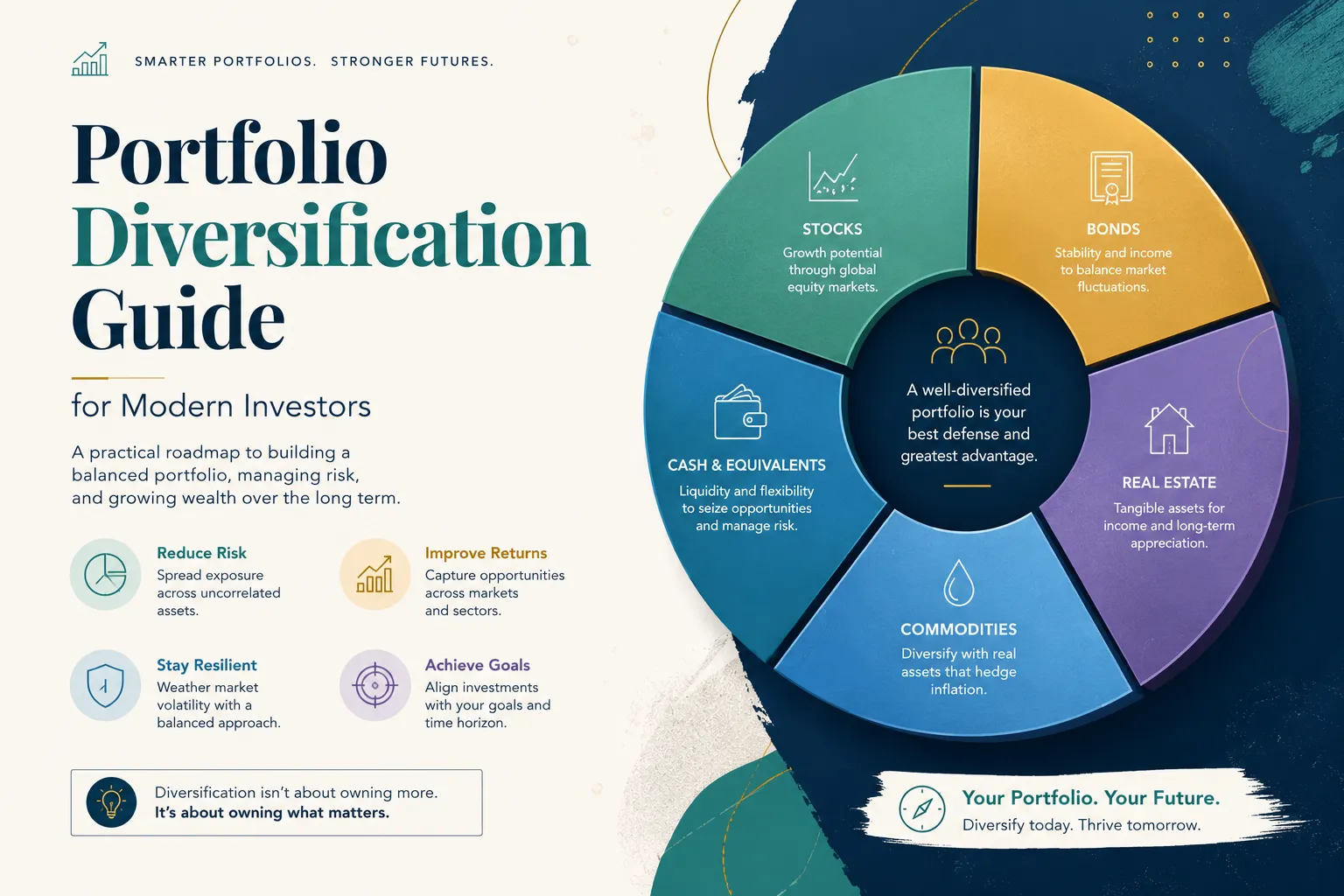
Portfolio Diversification Guide for Modern Investors
In today's rapidly evolving financial landscape, portfolio diversification has become one of the most important principles for successful investing. Modern investors face a unique combination of opportunities and challenges, including global market access, artificial intelligence-driven industries, economic uncertainty, inflation concerns, changing interest rates, geopolitical risks, and emerging asset classes. While these factors create significant wealth-building opportunities, they also increase the importance of managing investment risk effectively.
Portfolio diversification is often described as the foundation of intelligent investing. Rather than relying on a single stock, sector, country, or asset class, diversification spreads investments across multiple areas of the market. This approach helps reduce volatility, preserve capital during downturns, and improve the consistency of long-term portfolio performance.
Whether you're building your first investment portfolio or managing a multi-million-dollar wealth management strategy, understanding diversification can help you make smarter financial decisions and increase your chances of achieving long-term financial goals.
This comprehensive portfolio diversification guide explores modern diversification strategies, asset allocation principles, risk management techniques, portfolio construction methods, and investment opportunities that can help investors navigate the financial markets in 2026 and beyond.
What Is Portfolio Diversification?
Portfolio diversification is the practice of spreading investments across different asset classes, sectors, industries, geographic regions, and investment vehicles to reduce overall portfolio risk.
The core idea behind diversification is simple: not all investments perform the same way at the same time. When one investment experiences a decline, another may remain stable or appreciate in value, helping offset losses and smooth portfolio returns.
Instead of placing all your money into a single investment, diversification creates multiple sources of return while minimizing concentration risk.
Key Objectives of Diversification
- Reduce portfolio volatility.
- Protect against market downturns.
- Improve risk-adjusted returns.
- Create multiple growth opportunities.
- Generate consistent long-term performance.
- Enhance wealth preservation.
Why Diversification Matters More Than Ever in 2026
Modern markets are interconnected in ways never seen before. Global economic events can impact stocks, bonds, commodities, real estate, and currencies simultaneously. Additionally, technological disruption continues transforming industries at an accelerated pace.
Several factors make diversification increasingly important:
- Artificial intelligence adoption.
- Global economic uncertainty.
- Interest rate fluctuations.
- Inflationary pressures.
- Geopolitical events.
- Technology sector concentration.
- Changing retirement planning needs.
A diversified portfolio helps investors navigate these uncertainties without relying on a single market outcome.
The Relationship Between Risk and Diversification
Risk is an unavoidable component of investing. However, diversification helps reduce unsystematic risk, which refers to risks associated with individual companies, industries, or sectors.
| Risk Type | Description | Diversification Impact |
|---|---|---|
| Company Risk | Specific business issues | Significantly Reduced |
| Sector Risk | Industry-specific downturns | Reduced |
| Market Risk | Broad market declines | Partially Reduced |
| Interest Rate Risk | Rate-related asset declines | Managed Through Allocation |
| Inflation Risk | Loss of purchasing power | Managed Through Asset Mix |
While diversification cannot eliminate all risks, it can significantly reduce the impact of avoidable investment mistakes.
The Main Asset Classes for Diversification
1. Stocks (Equities)
Stocks provide ownership in businesses and remain one of the primary engines of long-term wealth creation.
Benefits include:
- Capital appreciation.
- Dividend income.
- Inflation protection.
- Participation in economic growth.
Within equities, diversification can be achieved through:
- Large-cap stocks.
- Mid-cap stocks.
- Small-cap stocks.
- Growth stocks.
- Value stocks.
- Dividend-paying stocks.
- International equities.
2. Bonds and Fixed Income
Bonds provide stability and income generation while reducing portfolio volatility.
Common bond categories include:
- Government bonds.
- Corporate bonds.
- Municipal bonds.
- Treasury securities.
- Inflation-protected securities.
Fixed-income investments often perform differently from equities, making them valuable diversification tools.
3. Real Estate Investments
Real estate remains one of the most popular diversification assets among high net worth investors.
Benefits include:
- Rental income.
- Property appreciation.
- Inflation protection.
- Portfolio diversification.
Investors can gain exposure through:
- Residential properties.
- Commercial real estate.
- Industrial properties.
- REITs.
- Data center real estate.
- Healthcare properties.
4. Cash and Cash Equivalents
Cash provides liquidity and flexibility. While it generally generates lower returns, cash serves several important functions:
- Emergency reserves.
- Investment opportunities.
- Volatility reduction.
- Risk management.
5. Alternative Investments
Alternative investments are becoming increasingly accessible to individual investors.
Examples include:
- Private equity.
- Private credit.
- Infrastructure funds.
- Commodities.
- Hedge fund strategies.
- Renewable energy projects.
These investments can provide additional diversification benefits due to lower correlations with traditional markets.
Sector Diversification Strategies
Even within stock portfolios, diversification remains critical.
| Sector | Investment Purpose |
|---|---|
| Technology | Growth |
| Healthcare | Defensive Growth |
| Financials | Economic Exposure |
| Consumer Staples | Stability |
| Industrials | Economic Expansion |
| Energy | Inflation Hedge |
| Utilities | Income Generation |
A diversified sector allocation prevents overreliance on a single industry.
Geographic Diversification
Many investors unintentionally concentrate portfolios within their home country. Geographic diversification expands opportunities while reducing country-specific risk.
Potential benefits include:
- Access to global growth.
- Reduced economic concentration.
- Currency diversification.
- Exposure to emerging markets.
- Broader investment opportunities.
Common Geographic Categories
- United States.
- Canada.
- Europe.
- Asia-Pacific.
- Emerging Markets.
- Global Developed Markets.
Modern Portfolio Allocation Models
Different investors require different allocation strategies based on age, risk tolerance, and financial goals.
| Portfolio Type | Stocks | Bonds | Real Estate | Alternatives | Cash |
|---|---|---|---|---|---|
| Conservative | 40% | 40% | 10% | 5% | 5% |
| Balanced | 60% | 20% | 10% | 5% | 5% |
| Growth | 75% | 10% | 10% | 3% | 2% |
| Aggressive Growth | 85% | 5% | 5% | 3% | 2% |
Portfolio allocations should align with investment objectives rather than short-term market forecasts.
The Role of ETFs in Diversification
Exchange-Traded Funds (ETFs) have revolutionized diversification by providing instant exposure to hundreds or thousands of securities.
Benefits include:
- Low costs.
- Broad diversification.
- High liquidity.
- Transparency.
- Tax efficiency.
Modern investors frequently use ETFs as core portfolio building blocks.
Index Funds and Passive Investing
Index funds continue gaining popularity because they offer efficient diversification with minimal management costs.
Popular categories include:
- Total market funds.
- S&P 500 funds.
- International index funds.
- Bond index funds.
- Dividend-focused funds.
For many investors, index funds provide a simple path toward diversified wealth accumulation.
Portfolio Rebalancing
Diversification requires ongoing maintenance. As markets fluctuate, asset allocations drift away from target percentages.
Rebalancing involves restoring intended allocations through:
- Selling overweight positions.
- Purchasing underweight assets.
- Adjusting new contributions.
Benefits include:
- Risk control.
- Disciplined investing.
- Reduced emotional decisions.
- Consistent strategy implementation.
Common Diversification Mistakes
Many investors believe they are diversified when they are actually concentrated in a few areas.
Avoid These Mistakes
- Owning too many similar investments.
- Overconcentration in technology stocks.
- Ignoring international markets.
- Holding excessive cash.
- Chasing recent performance.
- Neglecting portfolio reviews.
- Ignoring alternative assets.
Diversification for Retirement Planning
Retirement investors face unique challenges, including longevity risk, inflation, healthcare expenses, and income sustainability.
A diversified retirement portfolio can help:
- Generate reliable income.
- Maintain purchasing power.
- Reduce portfolio volatility.
- Support long-term withdrawals.
- Preserve capital.
How High Net Worth Investors Diversify
Wealthy investors often diversify beyond traditional stocks and bonds.
| Asset Category | Typical Use |
|---|---|
| Public Equities | Growth |
| Private Equity | Enhanced Returns |
| Commercial Real Estate | Income Generation |
| Private Credit | Yield Enhancement |
| Infrastructure Assets | Long-Term Stability |
| Cash Reserves | Liquidity |
These strategies emphasize both wealth creation and wealth preservation.
Technology and AI in Portfolio Management
Artificial intelligence is increasingly influencing investment management.
Modern portfolio tools can:
- Analyze risk exposure.
- Monitor diversification levels.
- Recommend rebalancing actions.
- Optimize tax efficiency.
- Track performance metrics.
Technology helps investors maintain disciplined diversification strategies while reducing manual oversight.
Building a Diversified Portfolio in 2026
A modern diversified portfolio should combine growth, income, stability, and flexibility.
| Asset Class | Sample Allocation |
|---|---|
| US Equities | 40% |
| International Equities | 20% |
| Bonds | 20% |
| REITs | 10% |
| Alternative Investments | 5% |
| Cash | 5% |
This structure provides exposure to multiple return drivers while maintaining diversification across asset classes.
Long-Term Benefits of Diversification
Over time, diversified portfolios often deliver several advantages:
- More consistent returns.
- Lower volatility.
- Reduced downside risk.
- Improved risk-adjusted performance.
- Greater emotional confidence.
- Enhanced retirement readiness.
Although diversification may occasionally underperform concentrated investments during specific market cycles, it often provides superior long-term risk management.
Conclusion
Portfolio diversification remains one of the most powerful tools available to modern investors. In an increasingly complex global economy, spreading investments across multiple asset classes, sectors, geographic regions, and investment vehicles can significantly improve risk-adjusted returns while reducing portfolio volatility.
Whether investing through ETFs, index funds, dividend stocks, bonds, real estate, or alternative assets, diversification creates a resilient foundation for long-term wealth creation. Successful investors understand that preserving capital is just as important as growing it, and diversification helps achieve both objectives simultaneously.
As financial markets continue evolving through technological innovation, artificial intelligence, and global economic shifts, diversified portfolio strategies will remain essential for investors seeking financial independence, retirement security, passive income generation, and sustainable wealth accumulation in 2026 and beyond.