Open Banking Explained for Consumers and Businesses
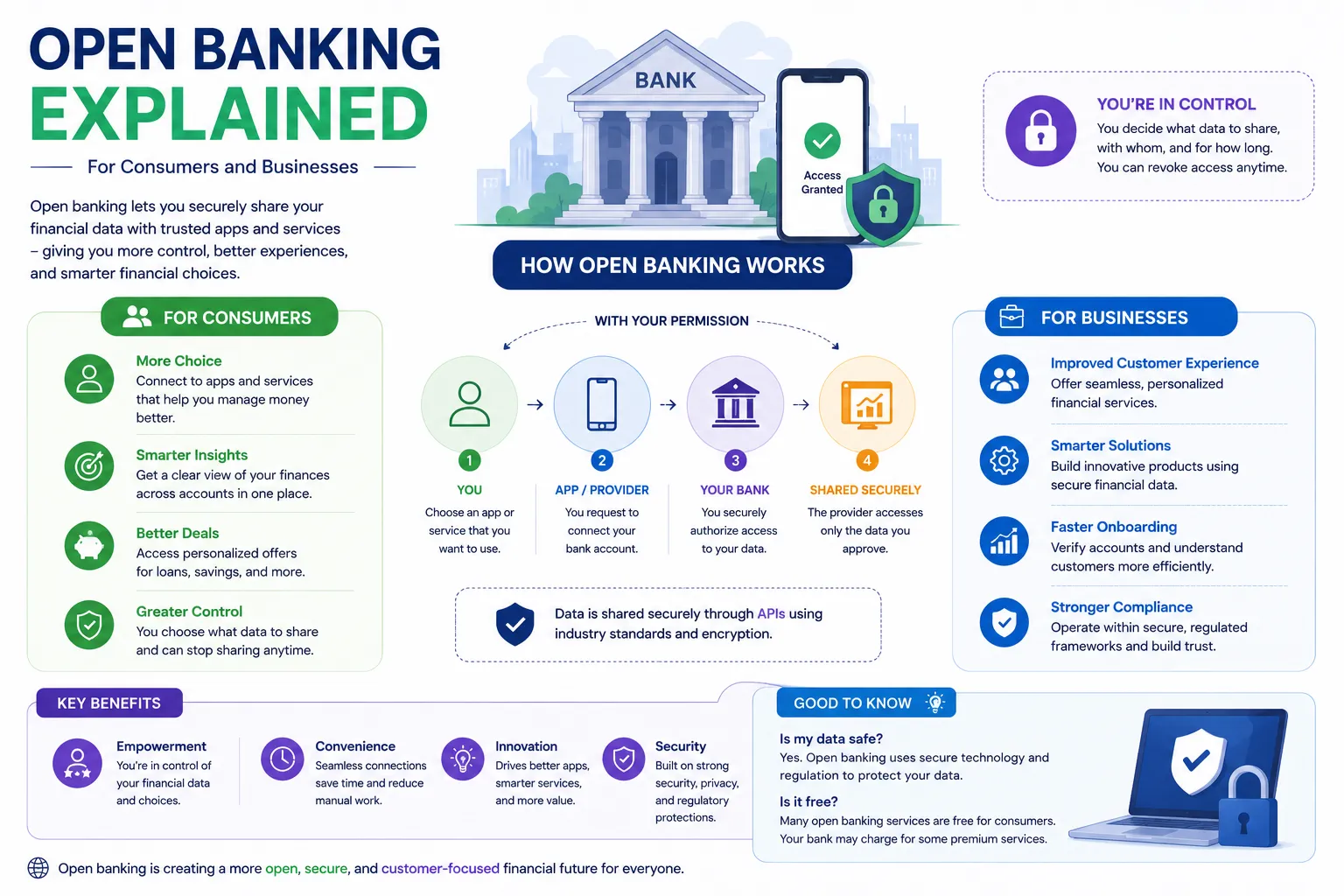
The banking industry is undergoing one of the most significant transformations in its history. Traditional financial systems are evolving into interconnected digital ecosystems where consumers and businesses can securely share financial data with authorized third-party providers. This evolution is known as open banking.
Open banking has become a major driver of financial innovation worldwide. By allowing customers to securely share banking information through application programming interfaces (APIs), open banking creates opportunities for better financial products, enhanced customer experiences, improved competition, and faster innovation across the financial services sector.
For consumers, open banking offers greater control over financial data and access to personalized financial services. For businesses, it creates new opportunities for payments, lending, financial management, cash flow optimization, and customer engagement.
As financial technology continues advancing in 2026 and beyond, understanding open banking has become essential for individuals, entrepreneurs, financial institutions, and enterprise organizations alike.
What Is Open Banking?
Open banking is a framework that allows banks and financial institutions to securely share customer-approved financial data with licensed third-party providers through standardized APIs.
Rather than keeping financial information isolated within a single institution, open banking enables customers to connect accounts, financial apps, payment platforms, and business tools through secure digital integrations.
The customer remains in control of data-sharing permissions, ensuring transparency and consent throughout the process.
| Traditional Banking | Open Banking |
|---|---|
| Data Stays Within Bank | Customer-Controlled Sharing |
| Limited Integrations | API Connectivity |
| Closed Ecosystem | Open Financial Ecosystem |
| Slower Innovation | Rapid Innovation |
| Restricted Services | Expanded Services |
How Open Banking Works
Open banking relies on secure APIs that allow approved financial service providers to access specific customer information after receiving explicit consent.
The process typically includes:
- Customer authorization
- Secure API connection
- Data verification
- Encrypted transmission
- Permission-based access
- Ongoing monitoring and compliance
This approach enables financial applications to access relevant information while maintaining security and privacy standards.
The Role of APIs in Open Banking
APIs are the technological foundation of open banking.
Application Programming Interfaces allow different software systems to communicate securely and exchange information efficiently.
In open banking environments, APIs enable:
- Account aggregation
- Payment initiation
- Transaction analysis
- Financial reporting
- Budgeting tools
- Lending assessments
API-driven connectivity is one of the primary reasons open banking continues gaining momentum globally.
Benefits of Open Banking for Consumers
Consumers are among the biggest beneficiaries of open banking innovation.
Advantages include:
- Improved financial visibility
- Personalized product recommendations
- Better budgeting tools
- Enhanced financial planning
- Faster payment experiences
- Greater account control
By connecting multiple accounts into unified financial dashboards, consumers can better understand their financial health and make more informed decisions.
Personalized Financial Services
One of the most valuable aspects of open banking is personalization.
Financial applications can analyze transaction data to provide:
- Customized budgeting recommendations
- Savings opportunities
- Investment insights
- Debt management strategies
- Financial wellness guidance
This level of personalization was difficult to achieve under traditional banking models.
Benefits of Open Banking for Businesses
Businesses can leverage open banking to improve operational efficiency, financial management, and customer experiences.
Key benefits include:
- Cash flow optimization
- Automated financial reporting
- Streamlined payment processing
- Improved lending access
- Enhanced accounting integration
- Real-time financial visibility
Open banking creates opportunities for businesses of all sizes to operate more efficiently.
| Business Function | Open Banking Benefit |
|---|---|
| Accounting | Automated Data Integration |
| Payments | Faster Processing |
| Treasury Management | Real-Time Visibility |
| Lending | Improved Access |
| Financial Reporting | Automation |
Open Banking and Digital Payments
Payment innovation is one of the fastest-growing areas within open banking.
Open banking payments offer:
- Direct account-to-account transfers
- Reduced payment fees
- Faster settlements
- Improved transaction transparency
- Enhanced payment security
Businesses increasingly adopt these solutions to improve customer experiences while reducing payment processing costs.
Open Banking and Lending Innovation
Lenders can use open banking data to make more informed credit decisions.
Rather than relying solely on traditional credit scores, lenders can evaluate:
- Cash flow patterns
- Income consistency
- Spending behavior
- Financial obligations
- Account activity
This can improve lending accuracy while expanding financial inclusion.
Open Banking and Financial Management Software
Financial management platforms increasingly integrate open banking functionality.
Popular capabilities include:
- Expense tracking
- Budget creation
- Cash flow forecasting
- Revenue analysis
- Investment monitoring
Consumers and businesses benefit from centralized financial insights across multiple institutions.
Security in Open Banking
Security remains one of the most important aspects of open banking.
Modern open banking systems employ:
- Strong encryption
- Multi-factor authentication
- Tokenized access controls
- Secure API gateways
- Continuous monitoring
- Fraud detection systems
These protections help ensure customer data remains secure during transmission and storage.
| Security Layer | Purpose |
|---|---|
| Encryption | Data Protection |
| Authentication | User Verification |
| Access Controls | Permission Management |
| Monitoring | Threat Detection |
| Compliance Audits | Regulatory Assurance |
Open Banking and FinTech Innovation
Open banking has become a catalyst for fintech innovation.
Fintech companies leverage open banking APIs to develop:
- Budgeting applications
- Investment platforms
- Lending marketplaces
- Personal finance tools
- Payment solutions
- Business finance software
This ecosystem encourages competition and drives continuous improvements in customer experiences.
The Rise of Open Finance
Open banking is evolving into a broader concept known as open finance.
Open finance expands data-sharing principles beyond banking to include:
- Investments
- Insurance
- Pensions
- Mortgages
- Business financing
This creates a more connected financial ecosystem with comprehensive financial visibility.
Open Banking and Embedded Finance
Embedded finance allows financial services to be integrated directly into non-financial platforms.
Examples include:
- Embedded payments
- Point-of-sale financing
- Digital wallets
- Insurance integration
- Business lending solutions
Open banking APIs play a critical role in enabling these experiences.
Challenges Facing Open Banking Adoption
Despite its advantages, open banking faces several challenges.
- Consumer awareness gaps
- Regulatory complexity
- Data privacy concerns
- Legacy infrastructure limitations
- Standardization issues
- Cybersecurity risks
Addressing these challenges will be important for long-term adoption and trust.
Regulatory Frameworks and Compliance
Open banking operates within regulatory frameworks designed to protect consumers and promote innovation.
Key regulatory objectives include:
- Consumer protection
- Data privacy
- Market competition
- Financial stability
- Operational transparency
Compliance remains a critical consideration for all participants in the open banking ecosystem.
Future Trends in Open Banking
Several trends are expected to shape the future of open banking.
- AI-powered financial insights
- Real-time payment expansion
- Open finance ecosystems
- Embedded financial services
- Enhanced API standardization
- Advanced cybersecurity frameworks
- Cross-border financial connectivity
These developments will further expand opportunities for consumers and businesses.
Why Businesses Should Pay Attention to Open Banking
Organizations that embrace open banking can gain competitive advantages through:
- Operational efficiency
- Better customer experiences
- Improved cash management
- Data-driven decision making
- Enhanced financial visibility
- New revenue opportunities
As digital transformation accelerates, open banking is becoming an essential component of modern business strategy.
Conclusion
Open banking represents a fundamental shift in how financial services are delivered and consumed. By enabling secure, customer-controlled data sharing through APIs, open banking creates new opportunities for innovation, efficiency, competition, and personalization.
Consumers benefit from greater financial control, personalized insights, and improved digital experiences. Businesses gain access to powerful financial tools, streamlined operations, and enhanced payment capabilities. Financial institutions and fintech companies can collaborate to deliver more innovative and customer-focused solutions.
As open banking continues evolving into broader open finance ecosystems, its impact on global financial services is expected to grow significantly. Organizations and individuals who understand and leverage these opportunities will be better positioned for success in the increasingly connected future of finance.