How International Trade Finance Supports Global Commerce
How International Trade Finance Supports Global Commerce
International trade finance serves as the backbone of modern global commerce. Every year, trillions of dollars worth of goods and services move across international borders, connecting manufacturers, suppliers, distributors, retailers, and consumers worldwide. Behind these transactions lies a sophisticated financial ecosystem designed to reduce risk, improve liquidity, and ensure that international trade can occur efficiently and securely.
Whether a company imports industrial equipment from Germany, exports technology products to North America, sources raw materials from Asia, or sells consumer goods throughout Europe, trade finance provides the financial instruments necessary to bridge the gap between buyers and sellers. Without trade finance, businesses would face significant challenges related to payment delays, foreign exchange volatility, credit risk, political uncertainty, and supply chain disruptions.
What Is International Trade Finance?
International trade finance refers to a collection of banking products, financing solutions, insurance instruments, and risk management tools designed to facilitate cross-border transactions. It helps businesses manage the complexities associated with importing and exporting goods while maintaining healthy cash flow and minimizing exposure to financial losses.
Trade finance solutions are commonly used by multinational corporations, exporters, importers, manufacturers, wholesalers, distributors, logistics providers, and small businesses participating in international markets.
| Trade Challenge | Trade Finance Solution | Business Benefit |
|---|---|---|
| Payment Risk | Letter of Credit | Guaranteed Payment |
| Cash Flow Constraints | Working Capital Finance | Improved Liquidity |
| Currency Volatility | FX Hedging | Stable Profit Margins |
| Buyer Default | Trade Credit Insurance | Risk Protection |
| Supply Chain Delays | Supply Chain Finance | Operational Stability |
The Role of Trade Finance in Global Commerce
Global commerce depends heavily on trust between trading partners. Buyers want assurance that goods will arrive as promised, while sellers want confidence that they will receive payment. Trade finance bridges this trust gap through financial guarantees and structured payment mechanisms.
International trade transactions often involve parties operating in different countries with varying legal systems, currencies, regulations, and business practices. Trade finance provides a standardized framework that reduces uncertainty and promotes commercial confidence.
Letters of Credit and Payment Security
Letters of credit remain among the most widely used trade finance instruments. A letter of credit is issued by a financial institution on behalf of a buyer, guaranteeing payment to the seller once specified contractual obligations are fulfilled.
This mechanism protects both parties by ensuring that payment is only released after shipping documents and contractual requirements have been verified. As a result, exporters can confidently ship goods internationally while importers gain assurance that payment conditions are tied to documented performance.
Export Finance and Business Growth
Export financing enables companies to fulfill large international orders without creating cash flow pressures. Exporters often face extended payment terms when selling internationally, which can create liquidity challenges.
Trade finance institutions provide pre-shipment financing, post-shipment financing, invoice financing, and receivables discounting solutions that help exporters maintain operations while awaiting payment from overseas buyers.
These financing structures are especially important for small and medium-sized enterprises seeking to expand internationally and compete with larger global organizations.
Import Finance and Inventory Management
Import financing helps businesses purchase goods from foreign suppliers while preserving working capital. Rather than paying for inventory immediately, importers can utilize structured financing solutions that spread payment obligations over time.
This flexibility allows businesses to maintain healthy liquidity levels while supporting growth initiatives, inventory expansion, and operational investments.
Supply Chain Finance Solutions
Supply chain finance has become one of the fastest-growing segments of trade finance. These programs allow suppliers to receive payment sooner while enabling buyers to extend payment terms.
Through supply chain finance arrangements, financial institutions provide funding based on the creditworthiness of the buyer rather than the supplier. This often results in lower financing costs and improved liquidity throughout the supply chain ecosystem.
| Participant | Benefit |
|---|---|
| Buyer | Extended Payment Terms |
| Supplier | Accelerated Cash Flow |
| Bank | Financing Revenue |
| Supply Chain | Greater Stability |
Foreign Exchange Risk Management
One of the most significant challenges in international trade involves currency fluctuations. Exchange rate movements can substantially impact profitability between the time a contract is signed and payment is received.
Trade finance providers offer various foreign exchange risk management tools, including forward contracts, currency swaps, options contracts, and hedging strategies. These instruments help businesses protect profit margins and improve financial predictability.
Trade Credit Insurance
Trade credit insurance protects businesses against customer non-payment. Coverage may extend to commercial defaults, insolvency events, political instability, and certain cross-border risks.
By reducing exposure to buyer default risk, trade credit insurance enables exporters to confidently enter new markets and expand customer relationships without assuming excessive financial risk.
Digital Transformation of Trade Finance
The trade finance industry is undergoing significant digital transformation. Traditional paper-based processes are increasingly being replaced by electronic documentation, automated workflows, cloud-based platforms, and digital verification systems.
Modern trade finance platforms provide improved transparency, faster transaction processing, enhanced compliance monitoring, and reduced operational costs.
Blockchain Technology in Trade Finance
Blockchain technology has emerged as a promising innovation within international trade finance. Distributed ledger systems can improve document verification, reduce fraud, increase transparency, and streamline transaction settlement processes.
While adoption remains in its early stages, blockchain solutions have the potential to significantly transform global trade infrastructure in the coming years.
Artificial Intelligence and Trade Finance Automation
Artificial intelligence is helping financial institutions improve risk assessment, fraud detection, document processing, and compliance monitoring. Machine learning algorithms can analyze vast amounts of transaction data to identify anomalies, predict risks, and support faster decision-making.
AI-driven automation reduces administrative burdens while enhancing operational efficiency across the trade finance lifecycle.
Trade Finance and Corporate Treasury Management
Corporate treasury departments play a crucial role in managing trade finance activities. Treasury teams oversee liquidity planning, foreign exchange exposure, working capital optimization, banking relationships, and funding strategies that support international trade operations.
Effective treasury management helps organizations maximize the benefits of trade finance while minimizing financial risks.
Challenges Facing International Trade Finance
Despite its importance, the trade finance sector faces several ongoing challenges, including geopolitical uncertainty, supply chain disruptions, cybersecurity risks, regulatory complexity, and financing accessibility gaps.
Many small businesses continue to struggle with obtaining affordable trade finance solutions, highlighting opportunities for innovation and financial inclusion.
Future Trends in Global Trade Finance
The future of trade finance is likely to be shaped by artificial intelligence, blockchain technology, real-time payments, open banking integration, embedded finance solutions, advanced analytics, and digital identity verification systems.
Financial institutions are investing heavily in technology to create faster, safer, and more accessible trade finance ecosystems capable of supporting growing global commerce demands.
Conclusion
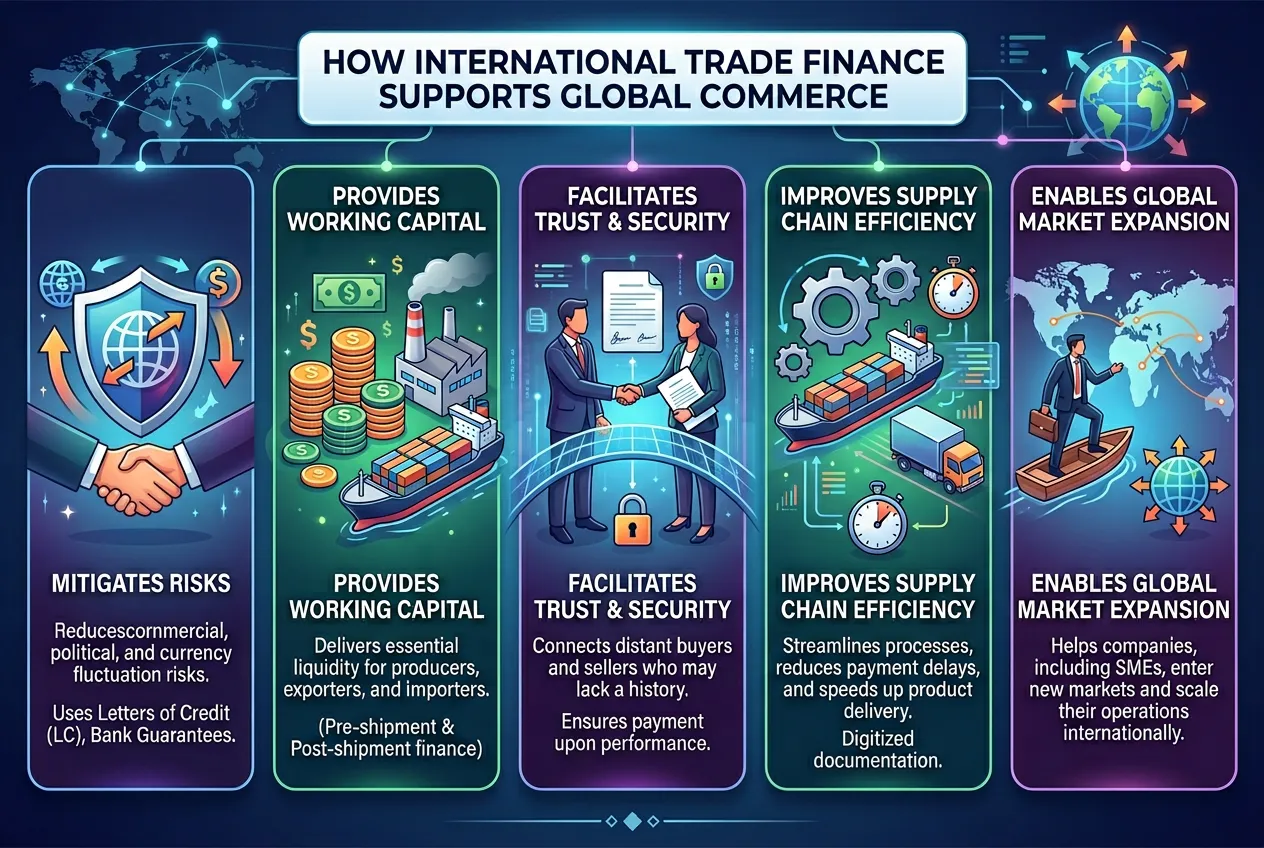
International trade finance remains one of the most important enablers of global commerce. By providing liquidity, reducing risk, facilitating payments, supporting working capital management, and improving supply chain efficiency, trade finance allows businesses to confidently engage in cross-border trade activities.
As global markets become increasingly interconnected and technology continues transforming financial services, trade finance will play an even greater role in supporting economic growth, international business expansion, and worldwide commercial development. Organizations that effectively leverage modern trade finance solutions can improve competitiveness, strengthen supply chain resilience, and unlock new opportunities across international markets.