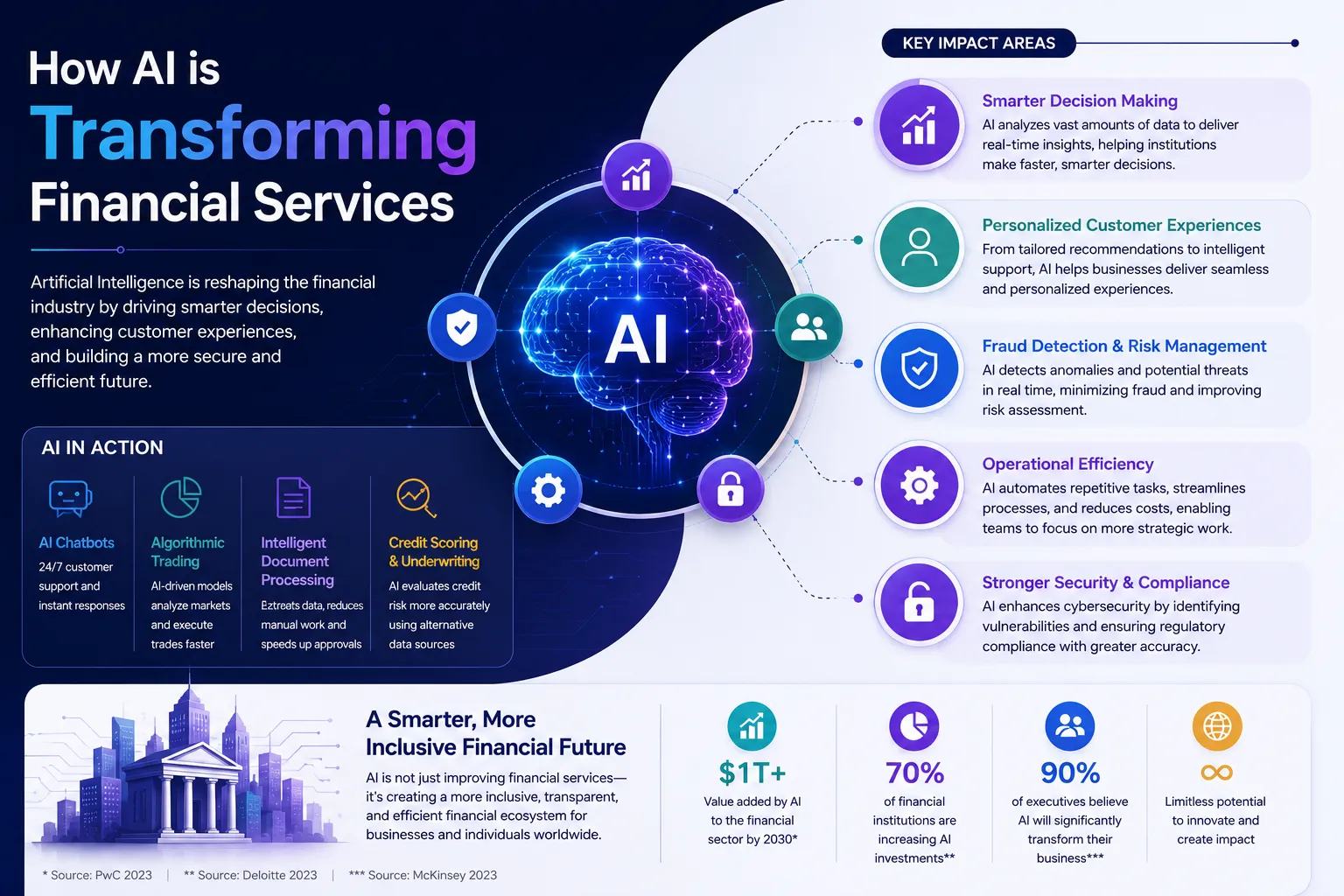
How AI is Transforming Financial Services
Artificial intelligence has emerged as one of the most disruptive technologies in the history of financial services. Banks, insurance companies, investment firms, payment processors, fintech startups, and wealth management organizations are increasingly leveraging AI-powered solutions to improve efficiency, strengthen security, automate operations, reduce costs, and deliver highly personalized customer experiences.
The financial services industry generates enormous amounts of data every day through transactions, customer interactions, market activity, lending decisions, compliance processes, and risk management operations. Traditional systems often struggle to process and analyze this information efficiently. Artificial intelligence addresses this challenge by enabling real-time analysis, predictive insights, intelligent automation, and data-driven decision-making at unprecedented scale.
As we move further into the digital economy, AI technologies such as machine learning, natural language processing, generative AI, predictive analytics, computer vision, and intelligent automation are becoming critical components of modern financial infrastructure. Financial institutions that successfully implement AI solutions are gaining significant competitive advantages while improving profitability and customer satisfaction.
This comprehensive guide explores how artificial intelligence is transforming financial services, the benefits it provides, emerging applications, implementation challenges, and future opportunities across the global financial ecosystem.
The Rise of Artificial Intelligence in Finance
Financial institutions have always relied on data-driven decision-making. However, the volume, complexity, and velocity of financial data have grown dramatically in recent years.
Artificial intelligence helps organizations:
- Analyze large datasets
- Identify hidden patterns
- Predict future outcomes
- Automate repetitive tasks
- Improve customer experiences
- Strengthen fraud prevention
- Enhance operational efficiency
AI technologies are now embedded in nearly every major area of financial services.
| AI Technology | Primary Financial Application |
|---|---|
| Machine Learning | Predictive Analytics |
| Natural Language Processing | Customer Service Automation |
| Generative AI | Content & Reporting |
| Computer Vision | Document Verification |
| Deep Learning | Fraud Detection |
AI-Powered Fraud Detection
Fraud prevention represents one of the most valuable applications of artificial intelligence in financial services.
Traditional fraud detection systems often rely on predefined rules that can struggle to identify sophisticated attacks. AI-powered fraud detection systems continuously analyze transaction behavior and customer activity to identify anomalies in real time.
Benefits include:
- Real-time fraud monitoring
- Reduced false positives
- Faster threat detection
- Improved customer protection
- Lower financial losses
Machine learning models continuously improve as they process additional transaction data.
Artificial Intelligence in Digital Banking
Digital banking platforms increasingly rely on AI to improve customer experiences and operational efficiency.
Modern AI-powered banking features include:
- Personalized financial insights
- Intelligent budgeting tools
- Predictive spending analysis
- Automated savings recommendations
- Virtual banking assistants
These capabilities help financial institutions deliver more personalized and engaging customer experiences.
AI Chatbots and Virtual Financial Assistants
Customer service automation has become a major focus area for financial institutions.
AI chatbots can:
- Answer account questions
- Process service requests
- Provide transaction information
- Support account management
- Assist with onboarding processes
Virtual assistants improve service availability while reducing operational costs.
Machine Learning in Credit Risk Assessment
Traditional credit evaluation often relies heavily on historical credit scores and limited financial data.
Machine learning models can analyze:
- Income patterns
- Payment histories
- Transaction behavior
- Financial stability indicators
- Alternative data sources
This enables more accurate credit risk assessment and expands access to financial products.
| Credit Evaluation Method | Traditional Approach | AI Approach |
|---|---|---|
| Data Sources | Limited | Extensive |
| Decision Speed | Hours or Days | Minutes or Seconds |
| Risk Accuracy | Moderate | Enhanced |
| Automation Level | Low | High |
Algorithmic Trading and Investment Management
Artificial intelligence has transformed investment management and capital markets.
AI-powered trading systems can:
- Analyze market trends
- Identify trading opportunities
- Monitor risk exposure
- Execute trades automatically
- Optimize portfolio allocation
Institutional investors increasingly utilize machine learning models to gain competitive advantages in financial markets.
Robo-Advisors and Wealth Management
Robo-advisors have revolutionized wealth management by making investment guidance more accessible.
AI-driven platforms can:
- Create diversified portfolios
- Perform risk assessments
- Rebalance investments
- Track financial goals
- Provide investment recommendations
These solutions help reduce costs while expanding access to financial planning services.
Predictive Analytics in Finance
Predictive analytics enables financial institutions to anticipate future outcomes based on historical and real-time data.
Applications include:
- Revenue forecasting
- Customer retention analysis
- Market trend prediction
- Liquidity management
- Credit default forecasting
Predictive intelligence improves strategic planning and operational decision-making.
Generative AI in Financial Services
Generative AI has become one of the most discussed innovations in financial technology.
Potential applications include:
- Automated report generation
- Research summarization
- Compliance documentation
- Client communication support
- Knowledge management systems
Financial institutions are actively exploring enterprise-grade generative AI solutions to improve productivity and efficiency.
Compliance and Regulatory Technology
Regulatory compliance remains one of the most resource-intensive aspects of financial services.
AI-powered compliance systems help organizations:
- Monitor transactions
- Detect suspicious activities
- Generate reports
- Track regulatory changes
- Reduce compliance costs
RegTech solutions are becoming increasingly important as regulatory requirements continue expanding.
| Compliance Function | AI Benefit |
|---|---|
| Transaction Monitoring | Automation |
| AML Screening | Improved Detection |
| Reporting | Efficiency Gains |
| Risk Monitoring | Real-Time Analysis |
| Audit Preparation | Documentation Automation |
AI for Financial Cybersecurity
Cybersecurity threats continue increasing across the financial sector.
AI-enhanced cybersecurity systems provide:
- Threat detection
- Behavioral monitoring
- Network analysis
- Fraud prevention
- Incident response automation
Machine learning algorithms can identify unusual behavior patterns that may indicate cyberattacks or account compromise.
Payment Processing and Transaction Intelligence
Payment processors increasingly rely on AI to optimize transaction flows and improve security.
Applications include:
- Fraud prevention
- Payment routing optimization
- Transaction categorization
- Risk assessment
- Customer behavior analysis
These technologies improve payment success rates while reducing operational risk.
Customer Personalization and Financial Wellness
Personalization has become a major competitive differentiator in financial services.
AI systems can deliver:
- Customized product recommendations
- Personalized savings plans
- Targeted investment suggestions
- Financial wellness insights
- Proactive account management
Consumers increasingly expect financial institutions to understand their needs and provide relevant recommendations.
Operational Automation and Efficiency
Many financial organizations are implementing intelligent automation solutions to streamline operations.
Automation opportunities include:
- Loan processing
- Document verification
- Account onboarding
- Claims processing
- Customer support workflows
Operational automation helps reduce costs while improving service delivery.
Challenges of AI Adoption in Finance
Despite significant benefits, AI implementation presents several challenges.
- Data privacy concerns
- Regulatory compliance requirements
- Model transparency issues
- Cybersecurity risks
- Implementation costs
- Talent shortages
Financial institutions must balance innovation with responsible governance and risk management practices.
The Future of AI in Financial Services
Artificial intelligence will continue playing an increasingly important role across the financial ecosystem.
Emerging developments include:
- Autonomous financial operations
- Advanced generative AI systems
- Hyper-personalized banking
- Predictive wealth management
- Real-time enterprise intelligence
- AI-powered treasury management
- Intelligent financial ecosystems
Organizations that successfully integrate AI into their business models will likely achieve significant competitive advantages over the coming decade.
Strategic Benefits for Financial Institutions
Financial organizations investing in AI technologies can realize numerous benefits, including:
- Lower operational costs
- Improved profitability
- Enhanced customer satisfaction
- Reduced fraud losses
- Better risk management
- Faster decision-making
- Increased scalability
These advantages make artificial intelligence one of the most valuable technology investments in modern finance.
Conclusion
Artificial intelligence is fundamentally transforming financial services by enabling smarter decision-making, advanced automation, enhanced security, personalized customer experiences, and improved operational efficiency. From fraud detection and credit scoring to wealth management and compliance monitoring, AI technologies are reshaping nearly every aspect of the financial ecosystem.
As machine learning, predictive analytics, generative AI, and intelligent automation continue evolving, financial institutions will unlock new opportunities for innovation and growth. Organizations that embrace responsible AI adoption while maintaining strong governance frameworks will be best positioned to thrive in the increasingly digital future of finance.
The future of financial services will be driven by intelligent systems capable of analyzing vast amounts of data, predicting outcomes, automating complex processes, and delivering highly personalized financial experiences at scale.