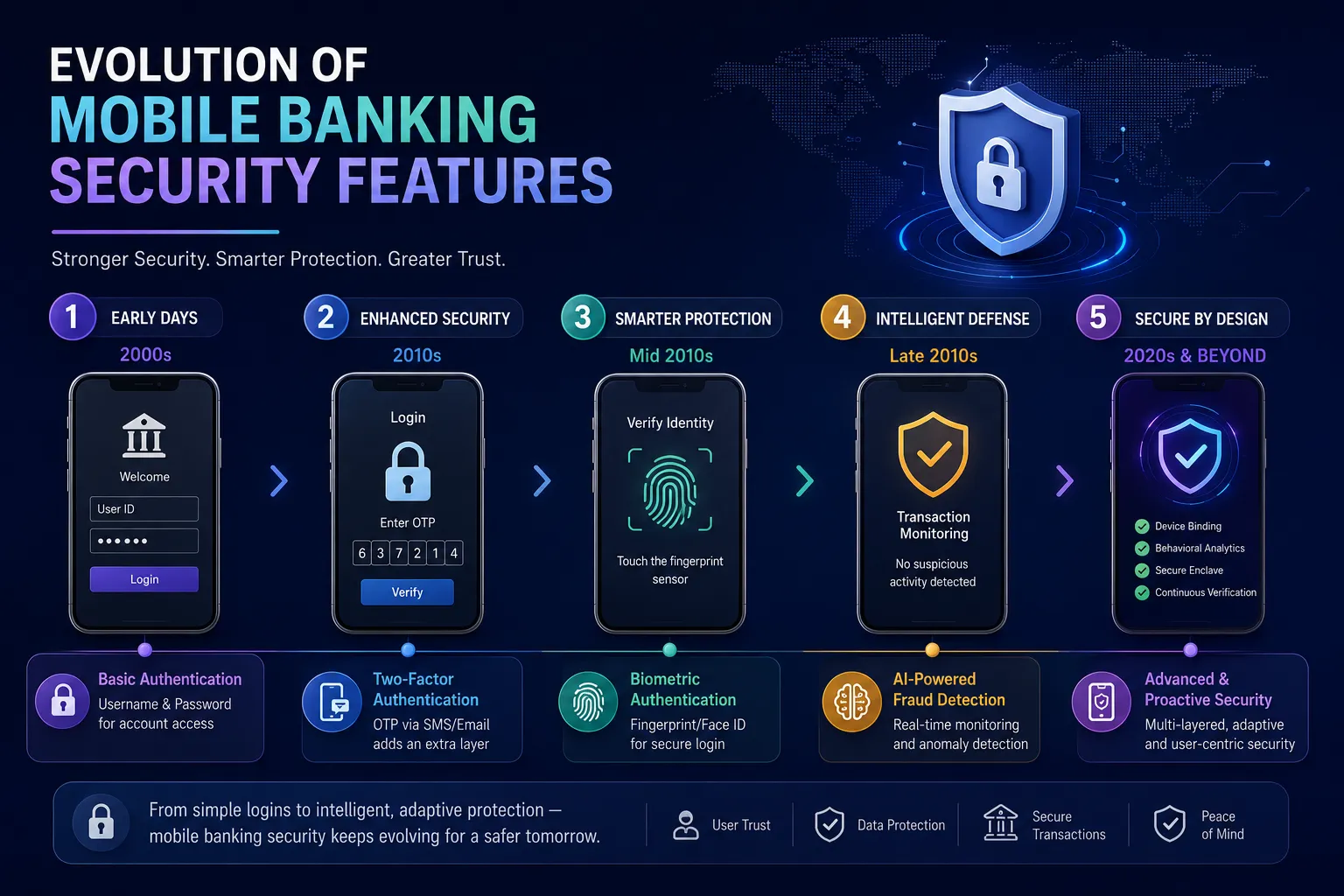
Evolution of Mobile Banking Security Features
Mobile banking has transformed the global financial industry by allowing consumers and businesses to manage accounts, transfer funds, pay bills, apply for loans, invest assets, and conduct financial transactions directly from smartphones and tablets. As mobile banking adoption continues growing across North America, Europe, Asia-Pacific, and emerging markets, cybersecurity has become one of the most critical priorities for financial institutions.
Financial institutions process trillions of dollars in digital transactions annually, making mobile banking platforms attractive targets for cybercriminals. To combat increasingly sophisticated cyber threats, banks have invested heavily in advanced security technologies, artificial intelligence, fraud prevention systems, behavioral analytics, biometric authentication, encryption frameworks, and real-time threat detection solutions.
The evolution of mobile banking security reflects the broader transformation of digital finance. Early banking applications relied primarily on passwords and basic encryption. Modern banking ecosystems now leverage machine learning, zero-trust architectures, device intelligence, behavioral biometrics, tokenization, and continuous authentication systems to secure customer accounts and transactions.
This comprehensive guide explores how mobile banking security has evolved, the technologies driving innovation, major cybersecurity threats, regulatory requirements, and future trends shaping secure digital banking experiences.
The Rise of Mobile Banking
The widespread adoption of smartphones fundamentally changed how consumers interact with financial institutions.
Mobile banking applications now support:
- Account monitoring
- Fund transfers
- Bill payments
- Remote check deposits
- Loan applications
- Investment management
- Digital wallet transactions
- Business banking services
As convenience increased, so did the need for stronger security frameworks capable of protecting sensitive financial information.
| Mobile Banking Function | Security Requirement |
|---|---|
| Account Access | Authentication Controls |
| Money Transfers | Transaction Verification |
| Bill Payments | Fraud Monitoring |
| Mobile Deposits | Identity Validation |
| Digital Wallets | Tokenization Security |
Early Mobile Banking Security Models
When mobile banking first emerged, security primarily relied on traditional username and password combinations.
Early systems focused on:
- Password authentication
- Basic SSL encryption
- Session management
- Account lockout mechanisms
- Simple fraud monitoring
While effective for the technology standards of the time, these methods became increasingly vulnerable as cybercriminals developed more sophisticated attack techniques.
The Growing Cyber Threat Landscape
The rapid growth of digital banking attracted cybercriminals seeking access to financial accounts and personal information.
Common threats included:
- Phishing attacks
- Credential theft
- Malware infections
- Keylogging software
- Identity theft
- Account takeover attacks
- Mobile device compromise
- Social engineering scams
Financial institutions responded by developing increasingly advanced cybersecurity frameworks.
Introduction of Multi-Factor Authentication (MFA)
One of the most significant advancements in banking security was the introduction of multi-factor authentication.
MFA requires users to provide multiple forms of verification before gaining account access.
Authentication factors typically include:
- Something the user knows (password)
- Something the user possesses (mobile device)
- Something the user is (biometric data)
MFA significantly reduces the risk of unauthorized account access.
| Authentication Method | Security Strength |
|---|---|
| Password Only | Moderate |
| Password + SMS Code | High |
| Password + Biometrics | Very High |
| Adaptive Authentication | Advanced |
Biometric Authentication Revolution
Biometric security transformed mobile banking by replacing traditional passwords with unique physical characteristics.
Common biometric technologies include:
- Fingerprint recognition
- Facial recognition
- Voice authentication
- Iris scanning
- Palm recognition
Biometrics offer both convenience and enhanced security because biometric traits are significantly harder to replicate than passwords.
Advanced Encryption Technologies
Encryption remains a cornerstone of mobile banking security.
Modern banking applications utilize sophisticated encryption standards to protect data during transmission and storage.
Encryption safeguards:
- Account information
- Transaction records
- Personal identification data
- Payment credentials
- Communication channels
Without strong encryption, sensitive financial data could be intercepted by malicious actors.
Tokenization and Payment Security
Tokenization has become a critical security feature within mobile banking and digital payment ecosystems.
Rather than transmitting actual payment card information, tokenization replaces sensitive data with unique digital tokens.
Benefits include:
- Reduced fraud exposure
- Enhanced transaction security
- Protection against data breaches
- Improved payment privacy
Tokenization is widely used in digital wallets and contactless payment systems.
Artificial Intelligence and Fraud Detection
Artificial intelligence has significantly improved fraud prevention capabilities.
AI-powered systems analyze massive volumes of transaction data in real time.
Capabilities include:
- Suspicious transaction detection
- Behavioral pattern recognition
- Anomaly identification
- Risk scoring
- Fraud prediction
Machine learning algorithms continuously improve detection accuracy as new threat patterns emerge.
| AI Security Function | Primary Benefit |
|---|---|
| Fraud Detection | Real-Time Protection |
| Behavior Analysis | Threat Identification |
| Risk Scoring | Transaction Evaluation |
| Predictive Analytics | Proactive Security |
Behavioral Biometrics
Behavioral biometrics represents one of the newest innovations in banking security.
Unlike traditional biometrics, behavioral systems analyze how users interact with devices.
Examples include:
- Typing patterns
- Swipe behavior
- Touchscreen pressure
- Navigation habits
- Device handling characteristics
Behavioral analytics helps identify suspicious activity even when valid credentials are used.
Device Intelligence and Risk-Based Authentication
Modern banking apps evaluate device characteristics before approving account access.
Factors analyzed may include:
- Device reputation
- Operating system version
- Geographic location
- Network characteristics
- Historical usage patterns
Risk-based authentication dynamically adjusts security requirements depending on detected risk levels.
Secure Mobile Payments and Digital Wallets
Mobile banking increasingly integrates with digital payment platforms.
Security technologies supporting mobile payments include:
- Tokenization
- Biometric verification
- Encrypted communications
- Secure element storage
- Transaction authentication
These protections help maintain consumer trust while supporting seamless payment experiences.
Zero Trust Security Architecture
Financial institutions are increasingly adopting zero-trust security frameworks.
The zero-trust model assumes that no device, user, or network should be trusted automatically.
Core principles include:
- Continuous verification
- Least-privilege access
- Identity validation
- Real-time monitoring
- Micro-segmentation
Zero-trust strategies reduce the risk of unauthorized access and insider threats.
Cybersecurity Compliance and Regulations
Mobile banking security is heavily influenced by regulatory requirements.
Financial institutions must comply with various standards designed to protect consumers and maintain financial stability.
Common compliance areas include:
- Data privacy protection
- Customer authentication requirements
- Fraud prevention standards
- Cybersecurity governance
- Incident reporting obligations
Compliance frameworks help establish minimum security expectations across the industry.
Account Takeover Prevention
Account takeover attacks remain one of the most serious threats facing digital banking platforms.
Modern prevention measures include:
- Behavioral monitoring
- Device fingerprinting
- Biometric verification
- Risk-based authentication
- Transaction anomaly detection
These tools significantly reduce successful account compromise attempts.
| Threat Type | Defense Mechanism |
|---|---|
| Phishing | MFA and Education |
| Credential Theft | Biometrics |
| Account Takeover | Behavioral Analytics |
| Payment Fraud | AI Monitoring |
| Data Breach | Encryption & Tokenization |
Cloud Security in Mobile Banking
Many banks now utilize cloud infrastructure to improve scalability and operational efficiency.
Cloud security controls typically include:
- Data encryption
- Identity management
- Continuous monitoring
- Threat intelligence
- Access controls
Properly implemented cloud environments can provide strong security while supporting innovation.
Open Banking Security Challenges
Open banking enables secure data sharing between financial institutions and third-party providers.
While open banking creates opportunities for innovation, it also introduces new security considerations.
Security requirements include:
- API protection
- Consent management
- Identity verification
- Access monitoring
- Data governance
Strong security frameworks are essential for maintaining trust in open banking ecosystems.
Artificial Intelligence and Future Threat Detection
The next generation of banking security increasingly relies on AI-driven threat intelligence.
Future systems may provide:
- Predictive threat analysis
- Autonomous fraud prevention
- Continuous authentication
- Advanced identity verification
- Real-time cyber defense
AI is expected to become a foundational component of future financial security architectures.
Emerging Mobile Banking Security Trends
Several technologies are shaping the future of mobile banking protection.
- Passwordless authentication
- Behavioral biometrics expansion
- AI-powered cybersecurity
- Quantum-resistant encryption
- Digital identity ecosystems
- Real-time fraud prevention
- Zero-trust implementation
- Advanced device intelligence
These innovations aim to improve both security and user experience.
Best Practices for Mobile Banking Users
Consumers also play an important role in maintaining banking security.
Recommended practices include:
- Using strong passwords
- Enabling multi-factor authentication
- Updating devices regularly
- Avoiding public Wi-Fi for banking
- Monitoring account activity
- Installing trusted applications only
- Reporting suspicious activity immediately
User awareness remains an important layer of defense against cyber threats.
Final Thoughts
The evolution of mobile banking security features reflects the rapid transformation of the financial services industry. From simple password-based authentication to sophisticated AI-powered fraud detection, biometric verification, behavioral analytics, and zero-trust security frameworks, banking institutions have continuously adapted to emerging cyber threats.
As digital banking adoption accelerates globally, security will remain a top priority for financial institutions, fintech companies, regulators, and consumers. Investments in artificial intelligence, cybersecurity automation, digital identity verification, and advanced encryption technologies are helping create safer financial ecosystems capable of supporting billions of secure transactions every year.
The future of mobile banking security will likely combine seamless user experiences with highly intelligent, adaptive security systems that continuously monitor, analyze, and protect financial activity in real time. Organizations that successfully balance innovation with robust cybersecurity practices will be best positioned to earn customer trust and thrive in the evolving digital economy.