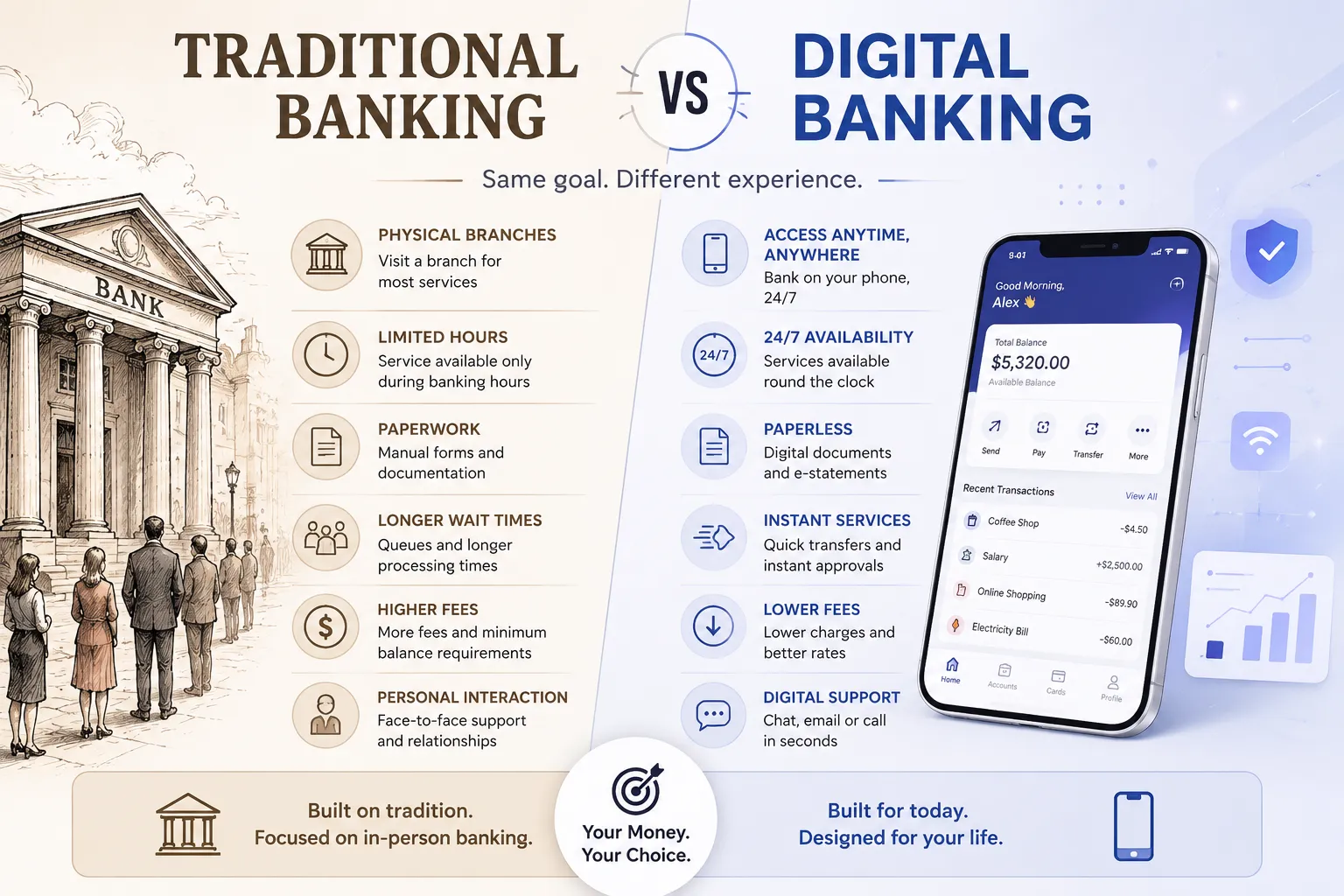
Comparing Traditional Banking vs Digital Banking
The banking industry has undergone a remarkable transformation over the past decade. What once required visits to physical branches can now be completed from a smartphone within minutes. As financial technology continues evolving, consumers and businesses increasingly face a choice between traditional banking institutions and digital-first banking platforms.
Both traditional banking and digital banking offer unique advantages. Traditional banks provide physical branch access, established reputations, and comprehensive financial services, while digital banks focus on convenience, lower costs, advanced technology, and seamless online experiences. Understanding the differences between these models is essential for making informed financial decisions.
With increasing adoption of mobile banking, artificial intelligence, cloud computing, open banking APIs, and real-time payment networks, digital banking is becoming a dominant force in global finance. However, traditional banks continue to play a critical role by offering personalized financial advice, business lending, wealth management, and relationship-based banking services.
This comprehensive guide compares traditional banking and digital banking across multiple factors including customer experience, fees, security, accessibility, technology, business services, lending solutions, and future growth trends.
Understanding Traditional Banking
Traditional banking refers to financial institutions that operate physical branch networks while offering a range of financial products and services. These banks have historically served as the foundation of the financial system and continue to manage trillions of dollars in deposits globally.
Common traditional banking services include:
- Checking accounts
- Savings accounts
- Mortgage lending
- Commercial loans
- Business banking
- Investment services
- Financial advisory solutions
- Treasury management
Traditional banks typically provide face-to-face support and extensive product offerings for individuals and businesses.
What Is Digital Banking?
Digital banking refers to financial services delivered primarily through online platforms, mobile applications, and digital channels. Digital banks often operate with minimal or no physical branches, allowing them to focus on technology-driven customer experiences.
Digital banking platforms offer:
- Online account opening
- Mobile banking applications
- Instant payments
- Digital wallets
- Automated budgeting tools
- Real-time notifications
- AI-powered financial insights
- 24/7 account management
Many digital banks are designed around convenience, speed, and cost efficiency.
| Feature | Traditional Banking | Digital Banking |
|---|---|---|
| Branch Access | Extensive | Limited or None |
| Account Opening | Often In-Person | Fully Online |
| Operating Costs | Higher | Lower |
| Technology Focus | Moderate | High |
| Customer Support | Branch + Online | Digital First |
Customer Experience Comparison
Customer experience is one of the most significant differentiators between traditional and digital banking models.
Traditional banks focus on personal relationships and face-to-face interactions. Customers can visit branches for assistance, consultations, and financial planning discussions.
Digital banks emphasize convenience and self-service capabilities. Customers can complete most transactions through mobile applications without visiting a physical location.
For tech-savvy users, digital banking often provides a faster and more streamlined experience.
Convenience and Accessibility
Digital banking offers unparalleled accessibility. Customers can access accounts, transfer funds, pay bills, and monitor transactions from virtually anywhere with internet connectivity.
Traditional banks provide accessibility through branch networks and ATMs but may require physical visits for certain services.
As remote banking becomes increasingly common, digital platforms continue gaining popularity among younger consumers and globally distributed businesses.
Account Opening Process
Traditional banks often require customers to visit branches, submit paperwork, and complete identity verification procedures in person.
Digital banks streamline onboarding through:
- Electronic verification
- Digital identity checks
- Online documentation
- Automated approvals
Many digital accounts can be opened within minutes, creating a significant competitive advantage.
Banking Fees and Costs
Operating costs significantly influence banking fee structures.
Traditional banks maintain branch networks, physical infrastructure, and larger staffing requirements, which may contribute to higher fees.
Digital banks often offer:
- Lower monthly fees
- Reduced transaction costs
- Competitive savings rates
- Lower foreign transaction fees
| Cost Area | Traditional Bank | Digital Bank |
|---|---|---|
| Monthly Maintenance | Moderate to High | Often Low |
| International Transfers | Higher Fees | Competitive Pricing |
| Account Opening | Variable | Often Free |
| ATM Fees | May Apply | Often Reimbursed |
Technology and Innovation
Digital banks are typically built on modern technology stacks designed for flexibility and rapid innovation.
Key innovations include:
- Artificial intelligence
- Machine learning analytics
- Open banking APIs
- Cloud-native infrastructure
- Automated financial planning
- Real-time fraud monitoring
Traditional banks are also investing heavily in digital transformation, though legacy systems can sometimes slow modernization efforts.
Mobile Banking Features
Digital banks often prioritize mobile experiences from the outset.
Popular features include:
- Instant spending alerts
- Automated savings tools
- Budget tracking
- Peer-to-peer payments
- Card management controls
- Investment integrations
Traditional banks increasingly offer similar capabilities but may vary by institution.
Security and Fraud Protection
Security remains a top priority across both banking models.
Modern security technologies include:
- Multi-factor authentication
- Biometric verification
- Fraud detection algorithms
- Data encryption
- Behavioral analytics
Digital banks often invest heavily in cybersecurity because their operations rely entirely on digital channels.
| Security Feature | Traditional Banking | Digital Banking |
|---|---|---|
| Biometric Login | Available | Common |
| Fraud Monitoring | Advanced | Advanced |
| Encryption | Standard | Standard |
| Real-Time Alerts | Moderate | Extensive |
Business Banking Services
Business banking remains an area where traditional banks maintain significant advantages.
Services often include:
- Commercial lending
- Treasury management
- Merchant services
- Cash management
- Trade finance
- Business advisory services
Digital banks continue expanding business offerings, particularly for startups, freelancers, and small businesses.
Lending and Credit Solutions
Traditional banks have long histories in mortgage lending, commercial loans, equipment financing, and wealth-backed credit facilities.
Digital lenders leverage:
- AI-powered underwriting
- Automated approvals
- Alternative credit scoring
- Faster decision-making
These innovations are helping expand access to credit while improving efficiency.
Personal Financial Management Tools
Digital banks frequently offer integrated personal finance tools that help customers monitor spending, track savings goals, and optimize financial behavior.
Features may include:
- Expense categorization
- Cash flow forecasting
- Savings automation
- Investment tracking
- Financial wellness insights
These tools contribute to growing consumer adoption of digital banking platforms.
Open Banking and Financial Ecosystems
Open banking enables secure data sharing between financial institutions and third-party providers.
Benefits include:
- Personalized services
- Improved competition
- Enhanced financial visibility
- Integrated financial products
Digital banks often leverage open banking frameworks more aggressively than traditional institutions.
The Future of Banking
The future of financial services will likely combine strengths from both traditional and digital banking models.
Emerging trends include:
- Embedded finance
- AI-driven banking
- Real-time payments
- Cloud banking platforms
- Digital identity systems
- Personalized financial experiences
Many traditional institutions are adopting digital-first strategies while digital banks continue expanding service offerings.
Which Banking Model Is Better?
The answer depends on individual and business needs.
Traditional banking may be preferable for customers seeking comprehensive financial services, in-person assistance, and complex lending solutions.
Digital banking often appeals to users prioritizing convenience, lower fees, mobile-first experiences, and technology-driven financial management.
Many consumers now utilize a hybrid approach, combining traditional banking relationships with digital banking tools to maximize flexibility and efficiency.
Conclusion
Traditional banking and digital banking each offer distinct advantages within the evolving financial landscape. Traditional institutions provide stability, comprehensive financial products, and relationship-based service, while digital banks deliver innovation, convenience, cost efficiency, and advanced technology experiences.
As financial technology continues advancing, the distinction between traditional and digital banking is gradually narrowing. Banks of all types are investing heavily in artificial intelligence, cybersecurity, mobile banking, automation, and cloud infrastructure to meet changing customer expectations.
Ultimately, the most successful financial institutions will be those that combine trusted banking fundamentals with modern digital innovation, creating secure, accessible, and customer-centric financial experiences for individuals and businesses alike.