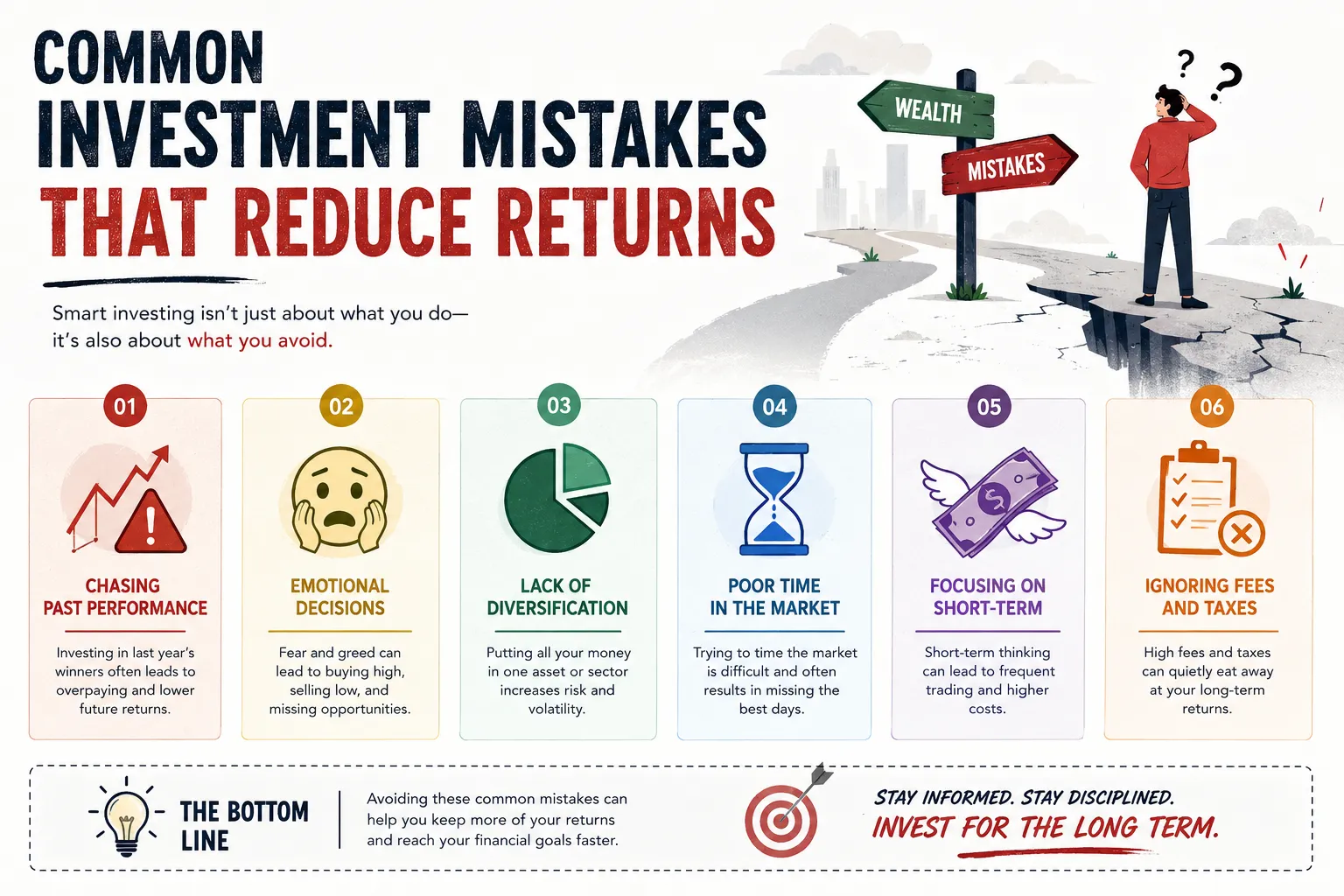
Common Investment Mistakes That Reduce Returns
Successful investing is often less about finding the perfect stock and more about avoiding costly mistakes. While financial markets offer tremendous opportunities for wealth creation, many investors unknowingly sabotage their returns through poor decisions, emotional reactions, lack of planning, and inefficient portfolio management.
In 2026, investors have unprecedented access to global markets, exchange-traded funds (ETFs), artificial intelligence-powered investing tools, alternative investments, and sophisticated portfolio management platforms. Yet despite these advantages, behavioral mistakes continue to be one of the largest obstacles to long-term wealth accumulation.
Research consistently shows that average investors frequently underperform the broader market not because of poor investment products, but because of poor investment behavior. Emotional decisions, market timing attempts, inadequate diversification, excessive trading, and failure to follow a disciplined strategy often result in significantly lower returns.
This comprehensive guide examines the most common investment mistakes that reduce returns and provides practical strategies to help investors build stronger portfolios, improve financial outcomes, and maximize long-term wealth creation.
Why Investment Mistakes Matter
Small investment mistakes can have major consequences over time. Because investing relies heavily on compound growth, every percentage point lost due to poor decisions can significantly impact future wealth.
For example, a portfolio earning 8% annually may generate dramatically different long-term results than a portfolio earning only 6% because of avoidable mistakes.
| Annual Return | $10,000 Investment After 30 Years |
|---|---|
| 6% | $57,435 |
| 8% | $100,627 |
| 10% | $174,494 |
This illustrates why avoiding mistakes can be just as important as selecting good investments.
Mistake #1: Trying to Time the Market
One of the most common investing mistakes is attempting to predict short-term market movements.
Many investors believe they can:
- Buy before markets rise.
- Sell before markets decline.
- Predict economic cycles.
- Identify market tops and bottoms.
In reality, consistently timing the market is extremely difficult—even for professional investors.
Missing just a few of the market's best-performing days can significantly reduce long-term returns. Investors who remain consistently invested often outperform those who frequently move in and out of the market.
Mistake #2: Emotional Investing
Emotions are among the biggest threats to investment success.
Common emotional reactions include:
- Panic selling during market declines.
- Buying during speculative bubbles.
- Fear of missing out (FOMO).
- Overconfidence during bull markets.
- Excessive pessimism during downturns.
Successful investors rely on disciplined strategies rather than emotional reactions to short-term market events.
Mistake #3: Lack of Portfolio Diversification
Concentrating investments in a few stocks, sectors, or industries increases risk significantly.
Diversification helps reduce:
- Company-specific risk.
- Sector concentration risk.
- Geographic risk.
- Economic cycle risk.
| Poor Diversification Example | Diversified Portfolio Example |
|---|---|
| 100% Technology Stocks | Stocks, Bonds, REITs, ETFs |
| Single Country Exposure | Global Market Exposure |
| Single Sector Focus | Multiple Sector Allocation |
A diversified portfolio generally provides more stable long-term returns.
Mistake #4: Chasing Performance
Investors often buy assets after strong performance and sell assets after poor performance.
This behavior frequently results in:
- Buying high.
- Selling low.
- Missing future recoveries.
- Reduced portfolio returns.
Historical performance does not guarantee future results, and yesterday's top-performing investments are not always tomorrow's winners.
Mistake #5: Ignoring Asset Allocation
Asset allocation is one of the most important drivers of long-term portfolio performance.
Many investors focus heavily on stock selection while ignoring broader portfolio construction.
Proper allocation considers:
- Risk tolerance.
- Investment goals.
- Time horizon.
- Income requirements.
- Liquidity needs.
An inappropriate asset allocation can expose investors to unnecessary risk or insufficient growth.
Mistake #6: Overtrading
Frequent trading can significantly reduce investment returns.
Overtrading often leads to:
- Higher transaction costs.
- Increased tax liabilities.
- Emotional decision-making.
- Reduced compound growth.
Long-term investing typically outperforms excessive trading for most investors.
Mistake #7: Neglecting Tax Efficiency
Taxes can substantially impact investment performance.
Common tax mistakes include:
- Frequent taxable sales.
- Inefficient asset placement.
- Ignoring tax-advantaged accounts.
- Poor capital gains planning.
Tax-efficient investing helps preserve more capital for future growth.
Mistake #8: Failing to Rebalance
Market performance can cause portfolio allocations to drift away from intended targets.
For example:
- Strong stock performance may increase equity exposure.
- Bond declines may reduce fixed-income allocations.
- Sector concentration may emerge unintentionally.
Periodic rebalancing helps maintain desired risk levels and investment objectives.
Mistake #9: Investing Without Clear Goals
Many investors enter financial markets without clearly defined objectives.
Common investment goals include:
- Retirement planning.
- Financial independence.
- Passive income generation.
- Education funding.
- Wealth preservation.
- Generational wealth transfer.
Specific goals provide direction and improve decision-making.
Mistake #10: Lack of an Emergency Fund
Investors who lack sufficient emergency savings may be forced to sell investments during unfavorable market conditions.
An emergency fund helps:
- Maintain investment discipline.
- Prevent forced liquidations.
- Reduce financial stress.
- Improve portfolio stability.
Liquidity remains a critical component of financial planning.
Mistake #11: Following Investment Trends Blindly
Every market cycle introduces popular trends and speculative opportunities.
Examples include:
- AI-related stocks.
- Hot technology sectors.
- Speculative growth companies.
- Emerging investment themes.
While trends may offer opportunities, investors should evaluate investments based on fundamentals rather than popularity.
Mistake #12: Ignoring Fees and Expenses
Investment fees may appear small but can significantly reduce returns over decades.
| Annual Fee | Impact on Long-Term Wealth |
|---|---|
| 0.10% | Minimal |
| 1.00% | Moderate Reduction |
| 2.00% | Significant Wealth Erosion |
Low-cost ETFs and index funds have become popular partly because they help investors retain more of their returns.
Mistake #13: Overconfidence
Successful investments can sometimes create excessive confidence.
Overconfident investors may:
- Take excessive risks.
- Ignore diversification.
- Increase leverage.
- Overestimate their forecasting abilities.
Maintaining humility and discipline helps reduce costly mistakes.
Mistake #14: Focusing Only on Returns
Many investors pursue the highest possible returns without considering risk.
Risk-adjusted returns often matter more than raw performance.
Key considerations include:
- Volatility.
- Drawdowns.
- Liquidity.
- Income generation.
- Portfolio stability.
A balanced approach typically leads to better long-term outcomes.
Mistake #15: Neglecting Retirement Planning
Retirement planning requires decades of preparation.
Common mistakes include:
- Starting too late.
- Underestimating future expenses.
- Ignoring inflation.
- Insufficient contributions.
- Overly conservative investing.
Early planning allows investors to maximize the benefits of compounding.
Mistake #16: Concentrating Employer Risk
Many professionals accumulate significant exposure to their employer through:
- Company stock.
- Stock options.
- Employment income.
- Retirement plans heavily invested in company shares.
This concentration can create significant financial risk if the company experiences difficulties.
Mistake #17: Ignoring Inflation
Inflation gradually reduces purchasing power.
Investors who focus solely on capital preservation may struggle to maintain real wealth over time.
Assets commonly used to combat inflation include:
- Stocks.
- Real estate.
- Dividend growth investments.
- Inflation-protected securities.
Mistake #18: Failing to Adapt as Life Changes
Investment strategies should evolve alongside personal circumstances.
Major life events include:
- Marriage.
- Children.
- Career changes.
- Business ownership.
- Retirement.
Regular portfolio reviews ensure alignment with changing goals.
Mistake #19: Neglecting Professional Guidance
While self-directed investing can be effective, some investors benefit from professional advice.
Financial professionals may assist with:
- Tax planning.
- Estate planning.
- Retirement strategies.
- Asset allocation.
- Risk management.
For complex financial situations, professional guidance can provide substantial value.
Mistake #20: Lack of Patience
Perhaps the most damaging mistake is expecting immediate results.
Wealth creation typically requires:
- Time.
- Consistency.
- Discipline.
- Patience.
- Long-term thinking.
Investors who remain committed to their strategy often achieve better outcomes than those constantly seeking quick gains.
How High Net Worth Investors Avoid These Mistakes
| Common Mistake | Successful Investor Approach |
|---|---|
| Market Timing | Consistent Investing |
| Emotional Decisions | Disciplined Strategy |
| Poor Diversification | Balanced Asset Allocation |
| Overtrading | Long-Term Focus |
| Ignoring Taxes | Tax-Efficient Planning |
| No Goals | Structured Financial Planning |
Building a Mistake-Resistant Investment Strategy
Investors can reduce errors by implementing several best practices:
- Create a written investment plan.
- Maintain diversification.
- Invest consistently.
- Rebalance periodically.
- Control emotions.
- Focus on long-term goals.
- Minimize unnecessary fees.
- Optimize taxes.
- Continue financial education.
These principles help create a resilient portfolio capable of supporting long-term wealth accumulation.
Conclusion
Investment success depends as much on avoiding mistakes as it does on selecting quality assets. Emotional reactions, market timing attempts, inadequate diversification, excessive trading, poor tax planning, and lack of discipline can significantly reduce returns and undermine financial goals.
Fortunately, most of these mistakes are preventable. By maintaining a long-term perspective, following a structured investment plan, diversifying intelligently, and focusing on consistent wealth-building habits, investors can improve portfolio performance and maximize the benefits of compound growth.
In the increasingly sophisticated financial landscape of 2026, the investors who achieve the greatest success are often not those who take the biggest risks, but those who consistently avoid the most common mistakes that reduce returns.